



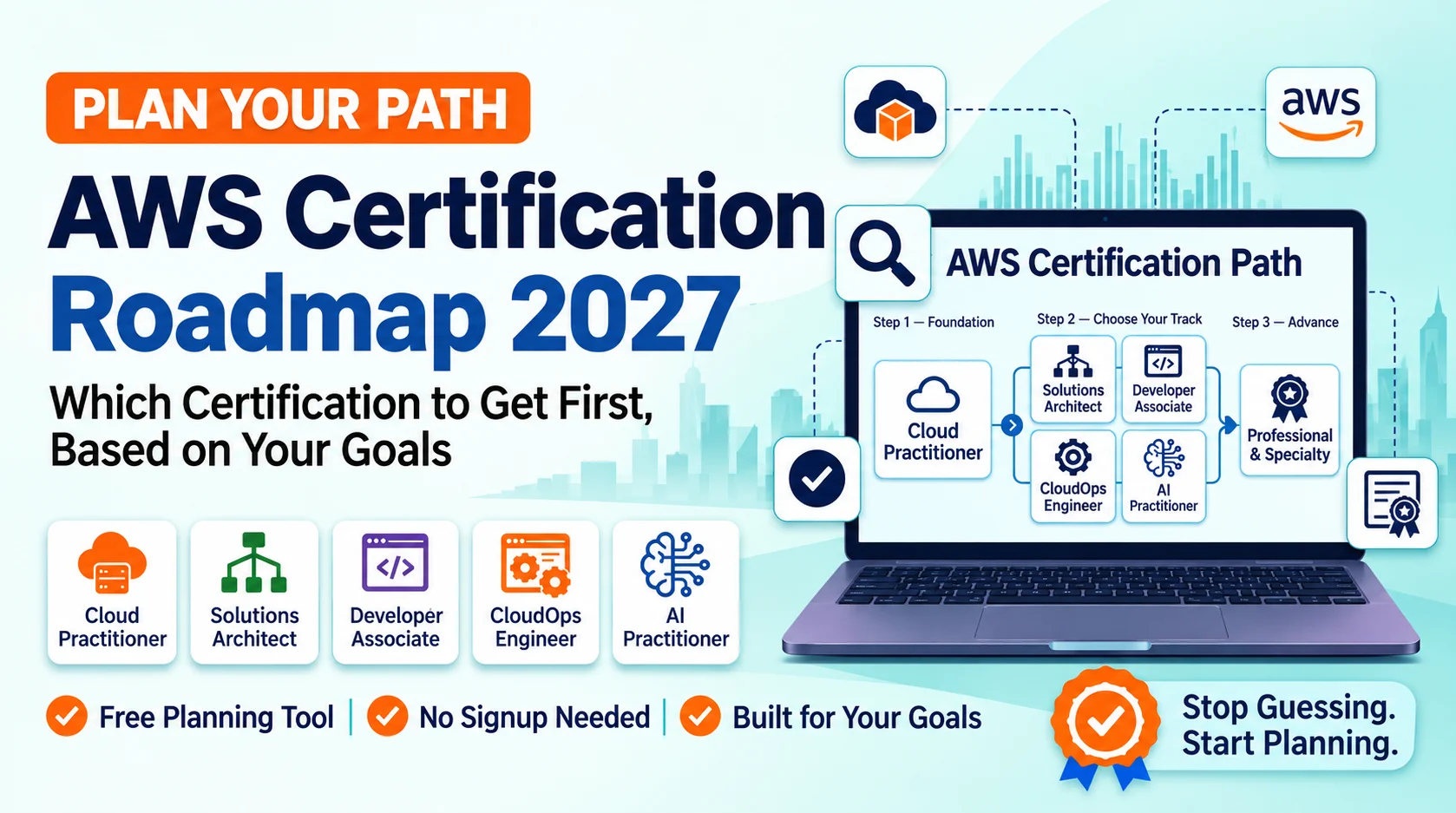
Most people should start with AWS Certified Cloud Practitioner if they are new to cloud computing, or jump straight into Solutions Architect Associate if they already have hands-on technical experience. Beyond that first exam, the right path depends less on which certification sounds impressive and more on the actual job you’re aiming for.
AWS now offers well over a dozen certifications, and that number keeps growing as new role-based exams get added. That range is exactly why so many people freeze before booking their first exam. This roadmap breaks the decision down clearly, based on your background, your goal, and the real changes AWS made to its certification catalog going into 2027.
AWS groups its certifications into four tiers, and understanding this structure makes the rest of the decision much easier.
| Level | Who It’s For | Typical Cost | Example Certifications |
|---|---|---|---|
| Foundational | Beginners, non-technical roles | $100 | Cloud Practitioner, AI Practitioner |
| Associate | Working technical roles | $150 | Solutions Architect, Developer, CloudOps Engineer |
| Professional | Senior technical roles | $300 | Solutions Architect Professional, DevOps Engineer Professional |
| Specialty | Deep expertise in one area | $300 | Security, Data Engineering, Machine Learning |
Every certification stays valid for three years before it needs to be renewed, and if you fail an exam, AWS requires a 14-day wait before you can retake it. That waiting period is one good reason to prepare properly rather than rushing into an exam underprepared.
It’s also worth understanding that AWS restructured this catalog around actual job roles rather than pure difficulty level. That means the right question isn’t “which exam is easiest,” it’s “which exam matches the work I actually do or want to do.” A business analyst moving into cloud strategy and a hands-on cloud engineer should not be following the same certification path, even if they’re both starting from zero AWS experience.
If you looked into AWS certifications a year or two ago, a few things have shifted, and it’s worth knowing before you plan your path.
The SysOps Administrator Associate certification was renamed and refreshed as CloudOps Engineer Associate, with a stronger focus on monitoring, deployment, and incident response, reflecting how operations roles actually work today.
The Machine Learning Specialty exam was retired, with a final test date of March 31, 2026. Anyone who already holds it keeps the credential active for the full three years from when they earned it, but new candidates should plan around the newer Machine Learning Engineer Associate exam instead.
AWS also added several new role-based credentials, including Data Engineer Associate, Machine Learning Engineer Associate, and Generative AI Developer Professional. These map more directly to actual job functions rather than narrow technical topics, which is a broader shift across the whole certification catalog: AWS is organizing exams around what people actually do at work, not just around individual services.
This shift matters more than it might seem at first glance. Older certification paths sometimes forced people to study services they would rarely touch in their actual job, just to pass a broad, generalized exam. The newer, role-based structure means the certification you earn maps more closely to the work you’ll actually be doing, which makes the study time itself more directly useful, not just a box to check on a resume.
The honest answer depends entirely on where you’re starting from, not on which exam looks the most impressive.
If you’re completely new to cloud computing or work in a non-technical role, start with Cloud Practitioner. It covers core cloud concepts, AWS’s global infrastructure, billing basics, and foundational security, without requiring any coding or hands-on labs. If your focus is specifically on AI and machine learning rather than general cloud infrastructure, AI Practitioner is a better foundational starting point instead.
If you already write code or work in software development, you can often skip straight to Developer Associate, which focuses on the services developers use daily, like Lambda, DynamoDB, and API Gateway, without spending time on Cloud Practitioner’s more general overview.
If you want the broadest, most widely recognized path, Solutions Architect Associate is the strongest general-purpose choice for most people. It’s consistently the highest-demand AWS certification by job posting volume, and it gives you exposure to a wide range of services rather than just one narrow area.
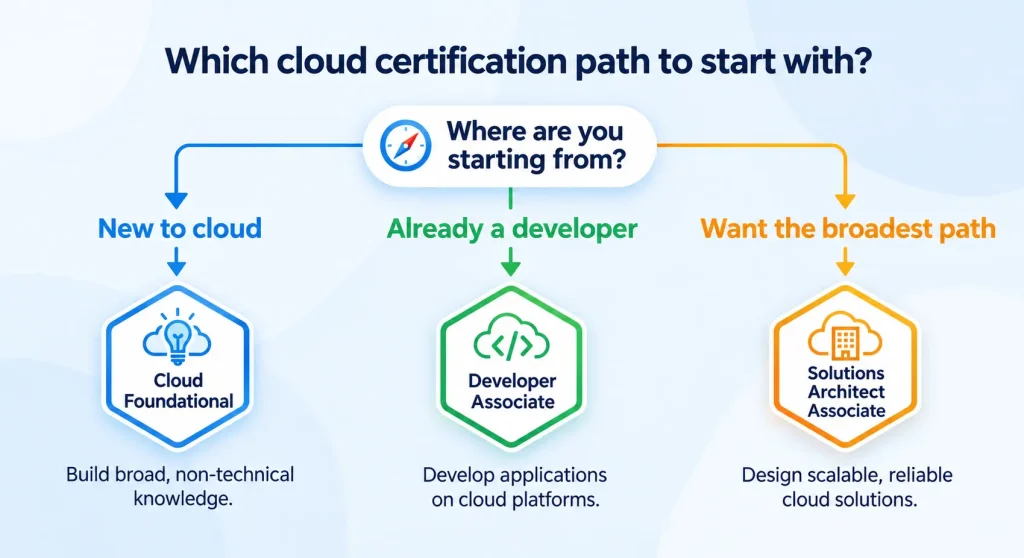
If you’re unsure and just want a dependable sequence, this is the path that works for the largest number of people: start with Cloud Practitioner if you want a structured beginner milestone, move into Solutions Architect Associate as your core technical certification, and then branch into either Solutions Architect Professional for a senior architecture track, or a Specialty certification that matches your actual role, such as Security, Data Engineering, or Machine Learning.
You do not need to collect every certification AWS offers. Two or three well-chosen credentials that build on each other and match your actual job function are far more valuable than a stack of unrelated badges. A documented, coherent path also tends to matter more to hiring managers than raw certification count, especially as multi-cloud environments become more common and employers care more about how well you understand the underlying concepts.
It’s worth resisting the temptation to chase every new specialty exam AWS releases, especially the newer AI-focused ones. Unless a certification maps directly to work you’re already doing or actively moving toward, that study time is often better spent going deeper on the path you’ve already started, or gaining real hands-on experience with the services your chosen track already covers.
Timelines vary based on your starting experience and how much time you can dedicate each week, but a few general benchmarks hold up well.
Going from zero experience all the way to a Professional-level certification typically takes somewhere between 8 and 14 months of consistent, part-time study. That might sound long, but most people are not trying to rush through every level at once, they’re building real skills alongside the exams, which is what actually makes the certification useful once you have it.
These numbers also assume genuinely consistent study, not a burst of effort followed by long gaps. Cloud concepts build on each other, and picking a study plan back up after a month away often means re-learning material you’d already covered. A slower, steadier pace of even 30 to 45 minutes a day tends to produce better results than occasional long weekend cramming sessions.
Rather than guessing which certification fits your situation, it helps to answer a few honest questions first: what’s your current technical background, what kind of role are you aiming for, and how much time can you realistically commit each week. Once you’re clear on those answers, the right starting point and sequence usually becomes obvious.
If you’d rather not work through that decision entirely on your own, our free AWS Certification Path Planner walks through a few quick questions about your experience and goals, then maps out a specific certification order tailored to you, rather than a generic one-size-fits-all list.
AWS Certified Cloud Practitioner is the standard starting point for complete beginners, since it requires no coding or hands-on labs and covers the foundational concepts every other certification builds on.
No, AWS does not enforce any prerequisites between certifications. However, Cloud Practitioner builds foundational knowledge that makes the Associate-level exams noticeably easier, so it’s worth considering if you don’t already have hands-on AWS experience.
Solutions Architect Associate consistently leads by job posting volume, followed by Solutions Architect Professional and DevOps Engineer Professional for more senior roles.
No, AWS retired it with a final test date of March 31, 2026. Anyone who already holds it keeps it active for three years from when they earned it, but new candidates should pursue Machine Learning Engineer Associate instead.
Most people are best served by two to three certifications that build on each other and match their actual job function, rather than collecting as many badges as possible. A focused, coherent path is generally viewed more favorably than a large, unrelated collection.
You’ll need to wait 14 days before retaking it. Since retakes require paying the exam fee again, it’s worth preparing thoroughly rather than attempting an exam before you’re ready.
It depends on your goals. If your work is genuinely centered on AI and machine learning, AI Practitioner followed by Machine Learning Engineer Associate makes sense as a dedicated track. If AI is only a small part of a broader cloud role, it’s usually better to build a strong general foundation first, like Solutions Architect Associate, before adding a specialized AI credential on top.
Every path in this guide is a general recommendation, but “general” is exactly the problem with most AWS advice online. Your actual starting point, whether you’re a non-technical analyst, a developer eyeing cloud infrastructure, or someone pivoting careers entirely, changes which certifications are worth your time and which ones just burn months you don’t have.
Our free AWS Certification Path Planner skips the guesswork. Answer a few quick questions about your background, your target role, and how many hours a week you can realistically study, and it maps out a specific certification sequence, not a copy-pasted list pulled from a dozen conflicting blog posts.

No Comments