

AI agents are not waiting for some distant future to enter the workforce. They are already answering customer complaints, reviewing contracts, screening job applicants, monitoring computer networks, writing software, and coordinating marketing campaigns.
Most people do not notice because much of this work happens quietly in the background. The customer receives a refund. The recruiter gets a ranked list of applicants. The security team receives an incident report. The final result may look as though it came from a person even when an AI system performed much of the work.
That does not mean these professions have disappeared. In most cases, AI agents are taking over specific workflows rather than replacing an entire occupation. Humans still set goals, review sensitive decisions, resolve unusual cases, and accept responsibility for the outcome.
Even so, the change is significant.
The important question is no longer whether AI agents will enter the workplace. It is how much work they are already doing and how quickly their responsibilities are expanding.
An AI agent is more than a chatbot.
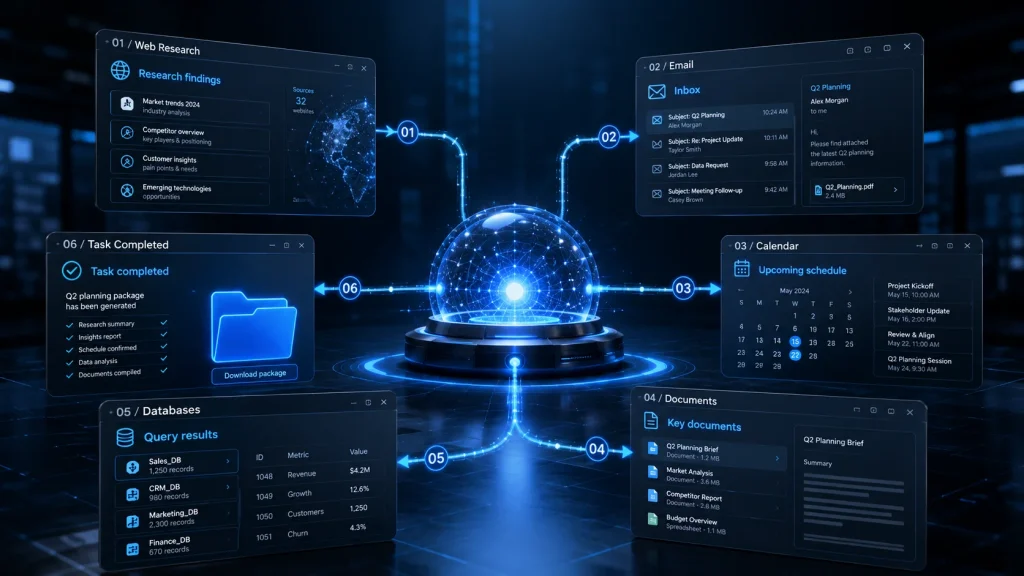
A conventional chatbot waits for a prompt and produces a response. An AI agent can be given a goal, decide which steps are required, use tools, collect information, perform actions, evaluate the result, and continue working until the task is complete.
Depending on the permissions it receives, an agent may be able to:
Consider the difference between asking a chatbot about a delayed flight and using an AI travel agent.
The chatbot explains what your options are. The agent monitors the flight, detects the delay, checks alternative routes, compares prices, evaluates your schedule, and presents the most practical rebooking choices.
The difference is not simply conversational ability. It is the ability to take coordinated action toward a goal.
AI adoption has moved quickly, but it is important not to confuse widespread experimentation with complete organizational transformation.
McKinsey’s 2025 global survey found that 88% of respondents said their organizations regularly used AI in at least one business function. However, only about one-third reported that their companies had begun scaling AI programs across the organization. In other words, AI use is widespread, but mature deployment is still developing.
AI agents are gaining attention because newer systems are better at following instructions, using software tools, processing large amounts of information, and completing multi-step workflows.
Businesses are therefore beginning with tasks that have four characteristics:
The following ten roles contain exactly those kinds of tasks.
Customer support is one of the clearest examples of AI agents moving beyond simple question-and-answer chatbots.
Earlier support bots were designed to answer basic questions such as:
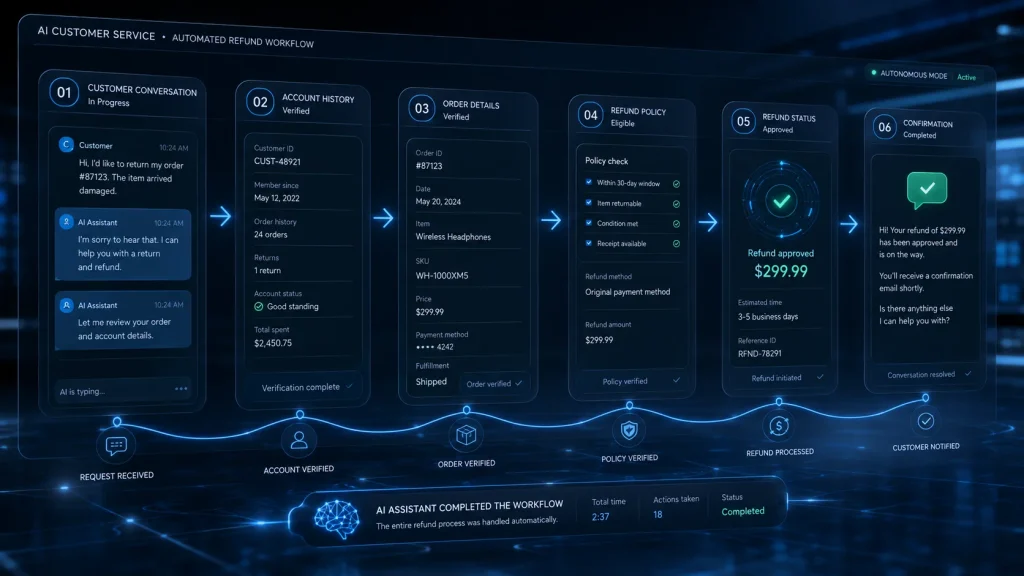
Modern support agents can perform actions inside customer-management, billing, and order-processing systems.
For example, an agent may:
Klarna provided one of the most widely discussed examples in 2024. The company reported that its AI assistant handled two-thirds of its customer-service chats during its first month, completed work equivalent to 700 full-time agents, and reduced average resolution time from 11 minutes to under two minutes. These were company-reported figures, but they demonstrated how quickly automated support could operate at scale.
Human representatives are still essential when a case involves emotional sensitivity, unclear policies, suspected fraud, legal risk, or a customer who wants a person.
However, the first line of support is increasingly being handled by software.
Much of legal work involves more than courtroom arguments and negotiations.
Law firms and in-house legal departments spend enormous amounts of time reviewing contracts, comparing clauses, checking documents against regulations, and searching large collections of files for relevant information.
These tasks are well suited to AI-assisted workflows.
A legal agent can examine a collection of agreements and identify:
Imagine a company considering the acquisition of another business. Thousands of contracts may need to be reviewed during due diligence.
Instead of asking a team of junior lawyers to begin with every document manually, an AI system can organize the files, extract important terms, flag possible risks, and create a structured summary. Lawyers can then focus their attention on the documents most likely to affect the transaction.
This does not eliminate the need for lawyers.
Legal language is highly dependent on context. A clause that appears risky in one agreement may be acceptable in another. Confidentiality, professional responsibility, factual accuracy, and jurisdiction-specific rules also require careful human oversight.
The change is that lawyers increasingly begin with an AI-generated analysis rather than a blank page.
Financial institutions have used automated trading systems for decades. AI agents extend that idea by combining more kinds of information and helping analysts monitor developments continuously.
An agent may track:
Suppose a company in an investment portfolio releases disappointing earnings while a regulator announces an investigation and several major customers reduce their orders.
A human analyst may eventually connect these events. An AI monitoring system can detect them as they occur, measure the portfolio’s exposure, summarize the likely risks, and alert the investment team.
In tightly controlled environments, automated systems may also rebalance positions or execute trades according to predefined limits.
That last point matters. Financial agents are not usually given unlimited freedom to buy and sell whatever they choose. Institutions establish exposure limits, approval requirements, audit trails, and risk controls.
The agent acts within a governed system. Human professionals remain responsible for investment strategy, risk tolerance, regulatory compliance, and unusual market conditions.
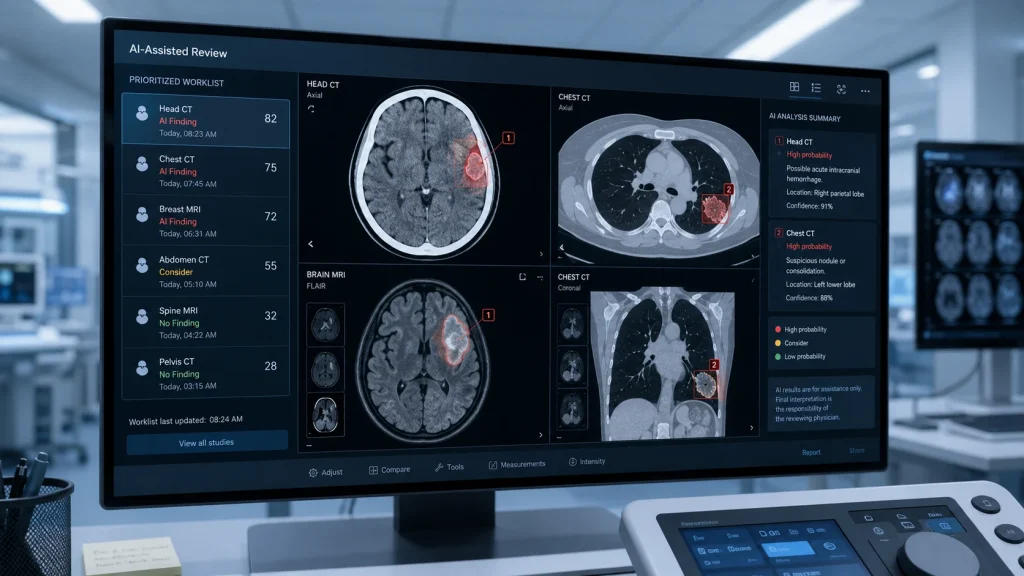
AI systems are increasingly used to help healthcare professionals analyze medical images and identify findings that may require attention.
Many AI-enabled medical devices have received authorization for use in the United States, and a large share of the devices listed by the U.S. Food and Drug Administration are associated with radiology.
Depending on the system and its authorized purpose, AI may help:
Consider an emergency department receiving hundreds of images. An AI system may flag a scan showing a possible intracranial hemorrhage and move it higher in the radiologist’s worklist.
The agent has not diagnosed the patient or chosen a treatment. It has helped direct attention to a potentially urgent case.
That distinction is essential.
Medical AI can make mistakes. Its performance may vary across hospitals, equipment, patient populations, and clinical conditions. Healthcare decisions also involve medical history, symptoms, laboratory results, patient preferences, and professional judgment—information that may not be visible in a single image.
The most responsible model is therefore not “AI instead of doctors.” It is AI assisting trained professionals while remaining subject to clinical validation, regulation, and human review.
Every day, major online platforms receive enormous volumes of posts, messages, images, videos, advertisements, and comments.
A human workforce alone cannot review all of that material before it reaches users. Automated systems therefore perform much of the initial detection and prioritization.
Content-moderation agents may look for:
More advanced systems evaluate context rather than relying entirely on blocked keywords.
For example, the same violent image could appear in journalism, historical education, documentary evidence, or propaganda. The surrounding text, account behavior, posting pattern, and audience can influence how the system classifies it.
Nevertheless, automated moderation remains imperfect.
It may remove legitimate speech, miss coded abuse, misunderstand humor, or apply policies inconsistently across languages and cultures. Platforms also change their enforcement policies over time, which affects what automated systems are instructed to remove or reduce.
As a result, human moderators remain necessary for appeals, ambiguous cases, policy design, and high-impact decisions.
AI performs much of the volume work. Humans are left with many of the most difficult judgments.
At large employers, a single vacancy may attract hundreds or thousands of applications.
Recruiting teams use automated systems to organize that volume, identify candidates who meet stated requirements, schedule interviews, and communicate with applicants.
An AI recruiting agent may:
This can make recruitment faster, but it can also create serious fairness problems.
An agent may undervalue unconventional career paths, misunderstand employment gaps, reproduce historical hiring biases, or favor applicants whose résumés use particular wording. A candidate can be rejected not because they lack ability, but because the system failed to recognize how their experience relates to the role.
For that reason, responsible employers should not treat an AI-generated score as an unquestionable verdict.
Human recruiters should examine how candidates are evaluated, test systems for unfair outcomes, provide accessible application processes, and review borderline or unusual cases.
Recruiting agents can reduce administrative work. They should not become invisible gatekeepers with no accountability.
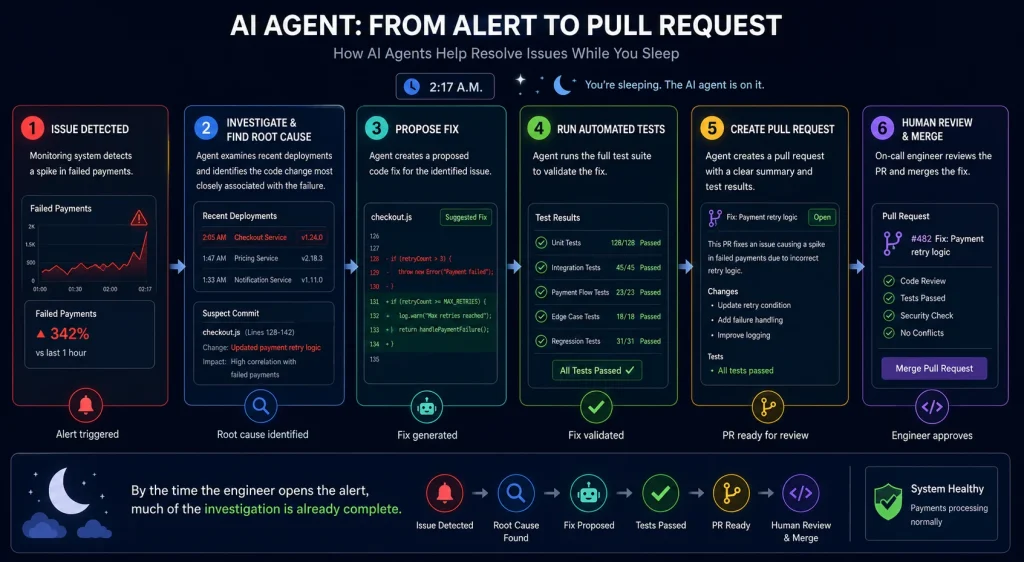
Imagine that a software problem occurs at 2:17 a.m.
A monitoring system detects a spike in failed payments. It examines recent deployments, identifies the code change most closely associated with the failure, creates a proposed fix, runs automated tests, and prepares a pull request for review.
By the time the on-call engineer opens the alert, much of the investigation may already be complete.
This is increasingly how AI agents are being introduced into software development and IT operations.
GitHub introduced a Copilot coding agent designed to work on development tasks, make changes in its own environment, and create a pull request for human review. GitHub says such agents can be assigned tasks such as fixing bugs, improving tests, and addressing technical debt.
AI agents can also assist with:
But software agents still require supervision.
A fix that passes automated tests may create a security weakness, break an uncommon workflow, or fail under real-world conditions. Granting an agent access to source code, cloud infrastructure, or deployment systems also creates new security risks.
The engineer’s role is therefore changing rather than disappearing.
Less time may be spent writing routine code from scratch. More time may be spent defining requirements, reviewing generated changes, designing systems, protecting infrastructure, and making architectural decisions.
Supply chains generate a continuous stream of operational decisions.
Inventory must be monitored. Shipments must be tracked. Suppliers must be evaluated. Unexpected delays must be managed. Prices and demand can change before a human team has time to prepare a report.
AI agents help by monitoring these variables simultaneously.
Consider a manufacturer that depends on a component shipped through a port affected by disruption.
A supply-chain agent might:
In some organizations, the agent may be allowed to place routine orders under an approved financial limit. Larger purchases, new suppliers, and strategic changes are usually escalated.
The greatest value is not simply speed. It is continuous awareness.
A human manager may review the supply chain every morning. An AI system can monitor it throughout the day and highlight the few events that need immediate attention.
Humans still negotiate important contracts, manage supplier relationships, evaluate ethical concerns, and decide how much risk the company should accept.
Cybersecurity teams face an uncomfortable imbalance.
Attackers can automate their activity, while defenders must monitor enormous amounts of data from devices, identities, cloud services, applications, and networks.
AI agents are being developed to help close that gap.
A cybersecurity agent may:
Microsoft announced Security Copilot agents designed to assist autonomously with areas including phishing, identity management, and data security. The company has also been integrating these agents into its wider security products.
Autonomy can be valuable because cyberattacks often unfold quickly. Waiting for a person to review every alert may give an attacker more time to move through a network.
However, automatic action also creates risk.
An agent that incorrectly blocks a critical server, disables a legitimate employee account, or misclassifies normal activity can disrupt the organization it is supposed to protect.
For this reason, companies commonly apply different permission levels. Low-risk actions may be automated, while more disruptive responses require approval.
The agent handles speed and scale. Human analysts handle strategy, accountability, and uncertainty.
Many people imagine AI marketing as a tool that writes advertisements or email subject lines.
That is only one part of the work.
A marketing agent can coordinate an entire sequence of decisions across customer segments, channels, and campaign stages.
For example, it may decide:
Imagine two customers visiting the same product page.
One is an existing customer who has purchased similar products before. The other is a first-time visitor who leaves after a few seconds.
An AI system may assign them to different campaigns, present different offers, and adjust the next message according to their behavior.
The process happens continuously and at a scale that would be impossible to manage manually.
Humans still define the brand, approve messaging, set budgets, establish ethical limits, and interpret customer needs. AI agents execute and optimize many of the individual decisions inside that strategy.
That power should be handled carefully. Excessive personalization can feel invasive, automated targeting can reinforce bias, and poorly governed campaigns can manipulate vulnerable customers.
Efficiency is not the same as responsibility.
The most accurate answer is: they are replacing some tasks, reducing demand for certain positions, creating new responsibilities, and changing the structure of many existing jobs.
The effect differs by occupation.
In customer support, a company may need fewer people handling repetitive questions. In medicine, AI is more likely to support clinicians than replace them. In software development, agents may reduce the time needed for routine coding while increasing the importance of review, system design, and security.
It is useful to think of a job as a collection of tasks.
A customer-support role may include:
An agent may perform the first four effectively while struggling with the final three.
Automation therefore changes the composition of the job before it eliminates the job itself.
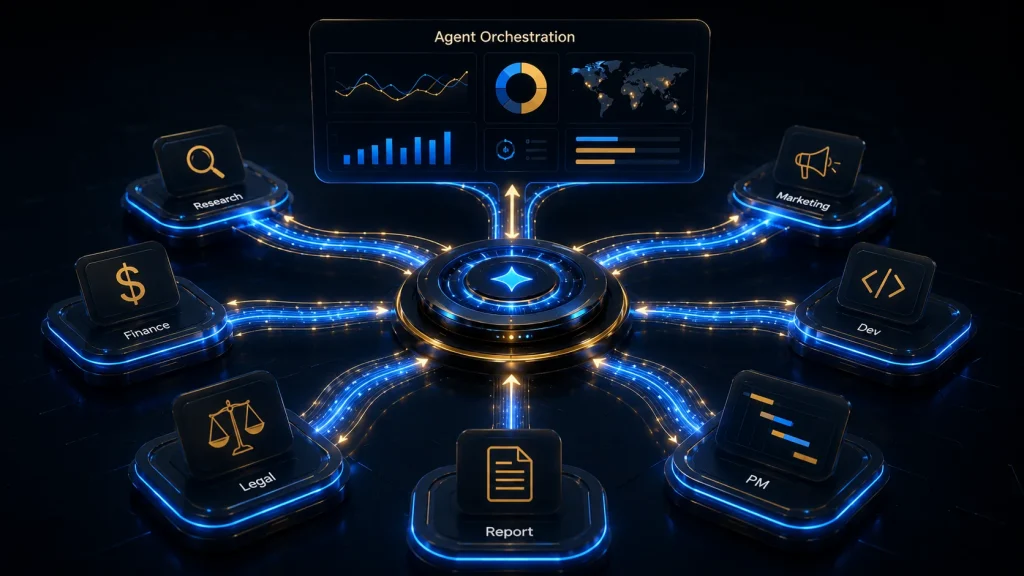
The next major development is not simply a more capable individual agent.
It is the orchestration of multiple specialized agents.
A coordinating agent could receive a broad objective such as launching a new product and divide it into separate assignments:
The coordinating system would combine their work, resolve basic conflicts, and present key decisions to a human manager.
This model could turn AI from a personal productivity tool into part of a company’s operational infrastructure.
It also introduces larger risks.
Errors can spread from one agent to another. Permissions can become difficult to control. Sensitive data may move between systems. Responsibility can become unclear when several automated components contribute to a decision.
The more authority agents receive, the more important governance becomes.
Trying to compete with AI at repetitive digital work is unlikely to be a lasting strategy.
A more practical approach is to become skilled at directing, evaluating, and improving AI-supported workflows.
That includes learning how to:
People who understand both their profession and the capabilities of AI agents will be better positioned than those who understand only one of them.
The valuable worker will not necessarily be the person who completes every step manually. It may be the person who knows which steps should be automated, which must remain human, and how to combine both safely.
AI agents are more capable than traditional chatbots because they can plan, use tools, perform actions, and work through multi-step tasks.
They are already being used in customer support, legal review, financial monitoring, healthcare, moderation, recruitment, software development, supply chains, cybersecurity, and marketing.
However, adoption is uneven. Many companies are still experimenting, and even organizations using AI often have not scaled it across the entire business.
In most industries, agents are automating parts of jobs rather than replacing every responsibility associated with a profession.
Human oversight remains especially important when decisions involve safety, law, finance, privacy, fairness, reputation, or irreversible consequences.
The next phase will involve groups of specialized agents coordinating with one another under human supervision.
The central workplace skill will increasingly be knowing how to delegate to AI without surrendering judgment, responsibility, or control.
No. A chatbot primarily responds to messages. An AI agent can work toward a goal by gathering information, using software, making limited decisions, performing actions, and checking whether the task was completed.
Some products combine both capabilities, so an agent may communicate through a chatbot-style interface.
In some companies and roles, automation has reduced the number of people required for repetitive work. In many other situations, agents assist employees rather than replace them.
The impact depends on the task, industry, company strategy, legal requirements, and reliability of the technology.
Yes.
Agents can misunderstand instructions, use inaccurate information, choose the wrong tool, overlook context, or perform an action that creates unintended consequences. High-impact systems therefore need testing, monitoring, permission limits, audit logs, and escalation procedures.
Roles containing repetitive, high-volume, computer-based workflows are the most exposed.
That does not always mean the entire role will disappear. More commonly, routine tasks are automated first, leaving humans responsible for exceptions, relationships, strategy, judgment, and accountability.
Strategic judgment, leadership, negotiation, creativity, domain expertise, and strong communication will remain valuable. These skills depend on human experience, context, and understanding.
The ability to supervise and evaluate AI systems will also become increasingly important. Workers must know when to trust AI and when human judgment is required.
It is possible that agents will eventually operate large parts of some businesses, especially digital companies with highly structured processes.
Completely autonomous companies are a much more uncertain prospect. Organizations operate within legal systems, human relationships, physical environments, and unpredictable markets. Even highly automated businesses will need clearly identified people who remain accountable for their decisions and consequences.






Comments are off for this post.