



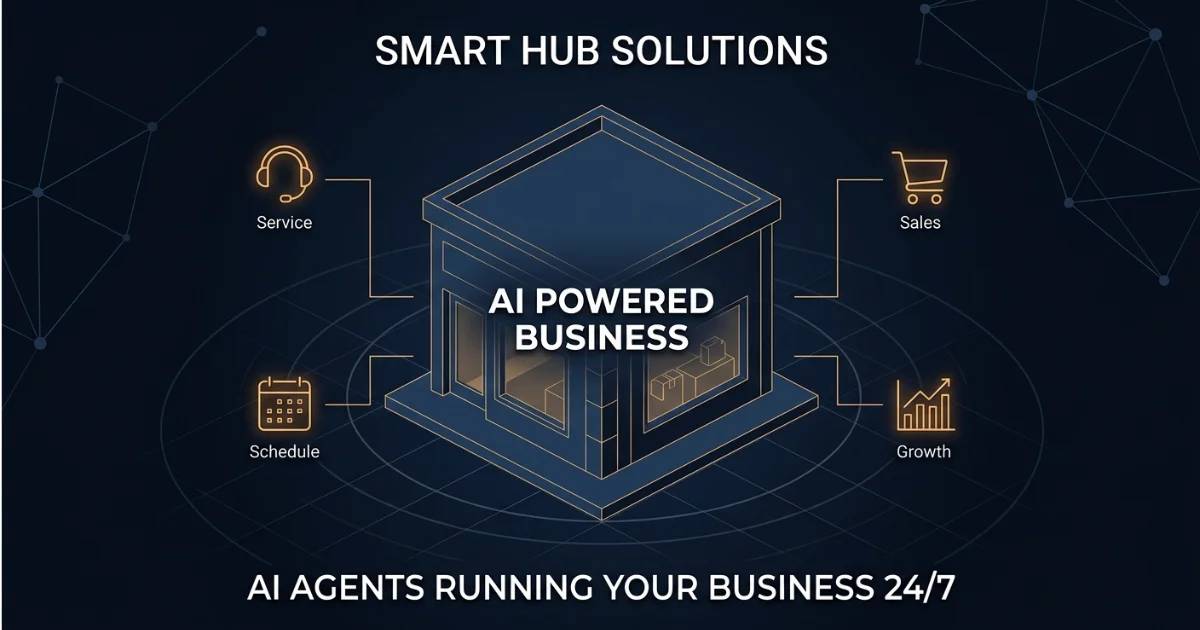
Hiring a full team to run your website around the clock is not realistic for most small businesses. But leaving it unattended after hours means missed bookings, unanswered questions, and abandoned carts that never come back. AI agents solve all of that, handling everything from customer support to content publishing while you focus on actually running your business.
In 2026, these tools are more accessible than ever. No technical skills. No big budget. This is not about replacing your team. It is about giving your website a brain that never sleeps.
This is where a lot of people get confused, so let’s clear it up right away.
A chatbot is reactive. It waits for someone to ask a question, matches it to a pre-written answer, and responds. It follows a script. Ask it something outside that script, and it falls apart.
An AI agent is different. It thinks, plans, and acts. It can observe what is happening on your website, make a decision, execute a task, check the result, and adjust all without you touching a thing. Think of it as the difference between a recorded voicemail greeting and a fully trained member of staff who genuinely understands your business.
In simple terms, a chatbot answers. An AI agent does.
For a small business website, this distinction matters enormously. An AI agent does not just talk to your visitors; it actively works to convert them, retain them, and serve them, around the clock.
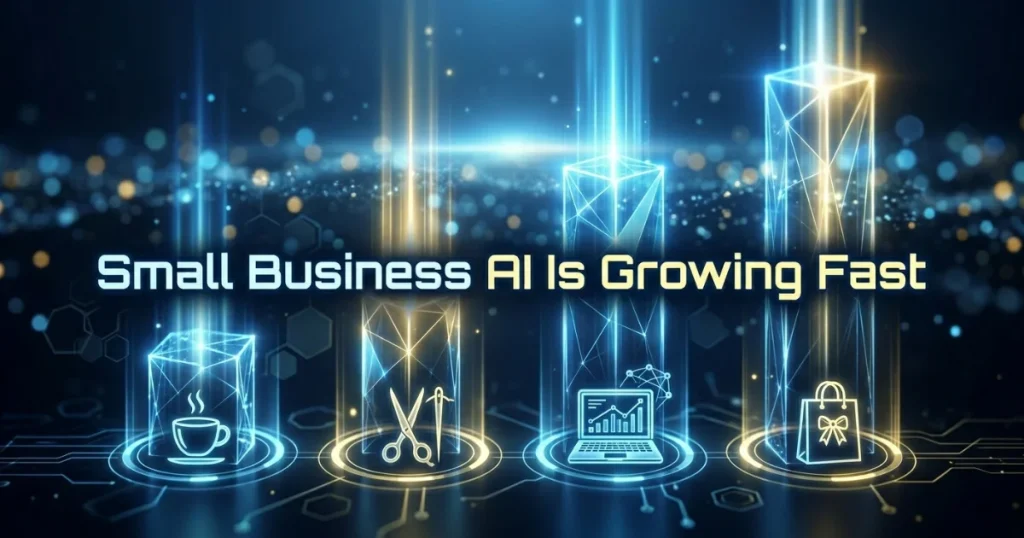
Here is the truth that most small business owners are only just waking up to: the playing field has changed. AI is no longer a luxury that only enterprise companies with massive tech budgets can afford. It has come down to the level where a two-person bakery, a solo consultant, or a local gym can deploy the same quality of automated website management that a corporation used to spend millions building.
The numbers back this up clearly:
The most telling stat of all: 83% of growing small businesses have adopted AI, compared to just 55% of declining ones. AI adoption is not just a trend; it is now a growth indicator.
If your website is still running entirely on manual effort, you are spending time and money you do not need to spend.
Understanding what is happening under the hood makes it much easier to trust these tools. AI agents on your website operate in a cycle: observe, decide, act, learn. Here is what that looks like in practice:
Step 1: Observe The agent monitors everything happening on your website in real time. Which pages visitors land on, how long they stay, what they click, what they put in their cart, and what form they started filling out but did not submit.
Step 2: Decide Based on what it observes, the agent makes a decision. A visitor has been on the pricing page for four minutes without clicking anything trigger a chat message. A customer abandoned their cart, so send a follow-up email in 30 minutes. A visitor is browsing winter products and surface winter recommendations.
Step 3: Act The agent executes the decision automatically. No one needs to be sitting at a desk waiting to respond. The action happens instantly, whether it is 11 AM or 2 AM.
Step 4: Learn Over time, the agent tracks which actions led to conversions and which did not. It adjusts its behavior accordingly. The longer it runs, the smarter it gets about your specific customers.
This loop runs continuously, across every visitor, every hour of every day, something no human team could replicate at the same cost.
This is where things get really practical. These are not theoretical use cases; they are what small business owners are actively deploying today.
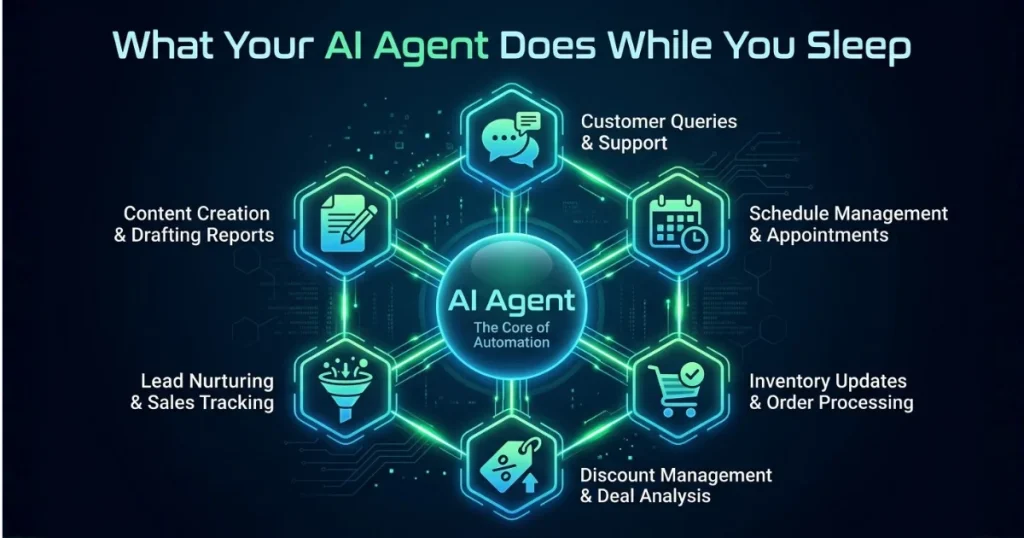
This is the most common entry point for small businesses, and for good reason. An AI agent handles incoming questions from website visitors at any hour, answering queries about pricing, availability, return policies, delivery timelines, and more without a human needing to be involved.
What makes this powerful is the quality of responses. Modern AI agents do not give robotic, generic answers. They understand context, refer back to earlier parts of the conversation, and hand off to a human team member when something genuinely requires personal attention.
Customer service chatbots have led to a 20% increase in customer retention rates for businesses that use them, and by 2026, generative AI is expected to handle up to 70% of customer interactions without human intervention.
For a small business that cannot afford a round-the-clock support team, this is transformative.
Service businesses, such as salons, consultants, fitness studios, and clinics, have found AI agents particularly valuable for handling bookings directly through their websites. A visitor arrives, an AI agent greets them, qualifies what service they need, checks availability in real time, and confirms the booking all within a single conversation.
No back-and-forth emails. No “let me check and get back to you.” No missed bookings because the phone was not answered. The appointment is locked in while the visitor is still engaged and ready to commit.
For small e-commerce businesses, AI agents track browsing behavior and purchase history to recommend products that actually match what each individual visitor is likely to want. This is the same technology Amazon built its entire recommendation engine on, now available to a small online shop through tools like Tidio, Klaviyo, or Shopify’s built-in AI features.
The impact is measurable. 69% of retailers leveraging AI agents report significant revenue growth due to personalized shopping experiences. Showing the right product to the right person at the right moment is not luck, it is an AI agent doing its job.
One of the most expensive problems in e-commerce is the abandoned cart. A visitor adds items, gets distracted, and leaves. Without automation, that sale is gone. With an AI agent, it triggers a recovery sequence: a personalized email, a follow-up reminder, sometimes a small discount offer timed and worded to bring the visitor back.
This happens automatically, for every single abandoned cart, at exactly the right intervals, without anyone on your team lifting a finger.
For service businesses and B2B companies, not every website visitor is worth the same follow-up effort. An AI agent can engage visitors through a conversation on your website, ask the right qualifying questions, determine whether the lead is a good fit, collect their contact details, and route hot leads directly to your sales inbox all before a human ever gets involved.
This means the time your team spends on follow-up is spent on people who are actually likely to become customers, rather than cold contacts who filled out a form with no real intent.
Some small businesses are now using AI agents to handle parts of their content operations. Blog post drafts, social media captions, email newsletters, and product descriptions, the agent generates a first draft based on your brand guidelines and topic inputs, which a human then reviews and refines before publishing.
Content marketing and generation is the most popular AI use case for small businesses, and it is easy to see why. Consistent content output is one of the hardest things for a small team to maintain. AI agents make it sustainable without requiring a full-time content hire.
You do not need to build anything from scratch. There is a growing ecosystem of affordable, no-code AI agent tools designed specifically for small business websites. Here is a quick breakdown of what is available:
| Tool | Best For | Starting Price |
|---|---|---|
| Tidio | Customer chat + AI support | Free / $29/mo |
| Intercom | Full customer platform with AI | From $74/mo |
| Zapier AI | Workflow automation across tools | Free / $20/mo |
| Klaviyo | Email + SMS AI automation | Free / $20/mo |
| Manychat | Messenger and Instagram AI agents | Free / $15/mo |
| Drift | B2B lead qualification | From $2,500/yr |
| Shopify AI | E-commerce recommendations | Built into Shopify |
| Zendesk AI | Customer support at scale | From $55/agent/mo |
Most of these tools offer free trials or free tiers, which means you can test an AI agent on your website before committing to any monthly cost. AI tools have become dramatically cheaper and easier to use. No-code AI tools eliminate the need for technical expertise, and most agents can be deployed in hours, not months.
Not everything about deploying AI agents is seamless. Here are the real problems small business owners run into and what to do about them.
“I don’t know where to start.” Start with customer support. It is the fastest ROI, the simplest setup, and the easiest to measure. Pick one tool; Tidio is a good starting point. Install it on your website, train it on your most common FAQs, and go live within a day.
“My customers won’t want to talk to a bot.” Modern AI agents do not feel like bots if they are set up properly. Use your brand’s natural tone, give the agent a name, and make sure it hands off to a real person smoothly when needed. Transparency builds trust most customers appreciate a fast, helpful response regardless of whether it came from a human or an agent.
“I’m worried about the cost.” Most small business AI tools start free or under $30 per month. Compare that against the cost of a part-time hire. The ROI calculation usually resolves itself quickly. Small businesses using AI are saving $500 to $2,000 per month while reclaiming 20+ hours of work weekly.
“What if it gives wrong information?” This is a valid concern. The solution is to train your agent on your specific content your FAQs, product details, policies, and service descriptions, rather than letting it respond from general knowledge. Most platforms make this easy through document uploads or URL scanning.
The trajectory here is clear. AI agents are going to become the standard layer of intelligence sitting between a small business website and its visitors, not a premium add-on, but a baseline expectation.
A few developments worth watching:
The AI agent market is projected to grow from $7.84 billion in 2025 to $52.62 billion by 2030, a 46.3% compound annual growth rate. The businesses that get comfortable with these tools now will have a significant operational advantage as the technology matures.
Running a small business website manually in 2026 is like running a shop with no staff. You end up doing everything yourself, stretched thin, missing opportunities while you sleep, and struggling to keep up with competitors who have quietly automated the parts of their business that used to eat their time.
AI agents do not ask for a salary. They do not take sick days. They do not forget to follow up. They just work on handling the repetitive, time-consuming parts of running a website so you can focus on the parts of your business that genuinely need your human judgment.
The technology is ready. The pricing is accessible. The results are proven.
The only question is how long you are willing to wait before you let your website start working as hard as you do.
Your website is open 24 hours a day. Make sure it is actually working all 24 of them.
No. Most modern AI agent tools are no-code, meaning you set them up through a visual interface, with no coding required. Many can be installed on your website in under an hour. If you want to go further, you can even build a full app in 2 hours using AI with no coding skills at all.
Yes. Most tools integrate with WordPress, Shopify, Wix, Squarespace, Webflow, and custom-built sites through a simple script or plugin installation.
Not entirely, and that is not the goal. AI agents handle the high volume of routine, repetitive interactions, freeing your team to focus on complex situations that genuinely need a human touch. Most businesses find that AI agents make their existing team more capable, not redundant.
Most businesses report measurable improvements within the first two to four weeks. Response times improve immediately. Conversion impacts from features like cart recovery and personalization typically show up within the first month.
Reputable platforms comply with GDPR, CCPA, and other data protection regulations. Always review the privacy policy of any tool before deploying it, and check that customer data is not being used to train third-party models without consent.
Tidio offers a solid free tier that includes AI chat, basic automation, and visitor tracking. It is one of the most accessible starting points for small businesses with no prior AI experience.
Indirectly, yes. AI agents that improve page engagement time, reduce bounce rates, and increase return visitor rates send positive signals to Google. Content automation tools also help you publish more consistently, which supports long-term SEO growth.






Comments are off for this post.