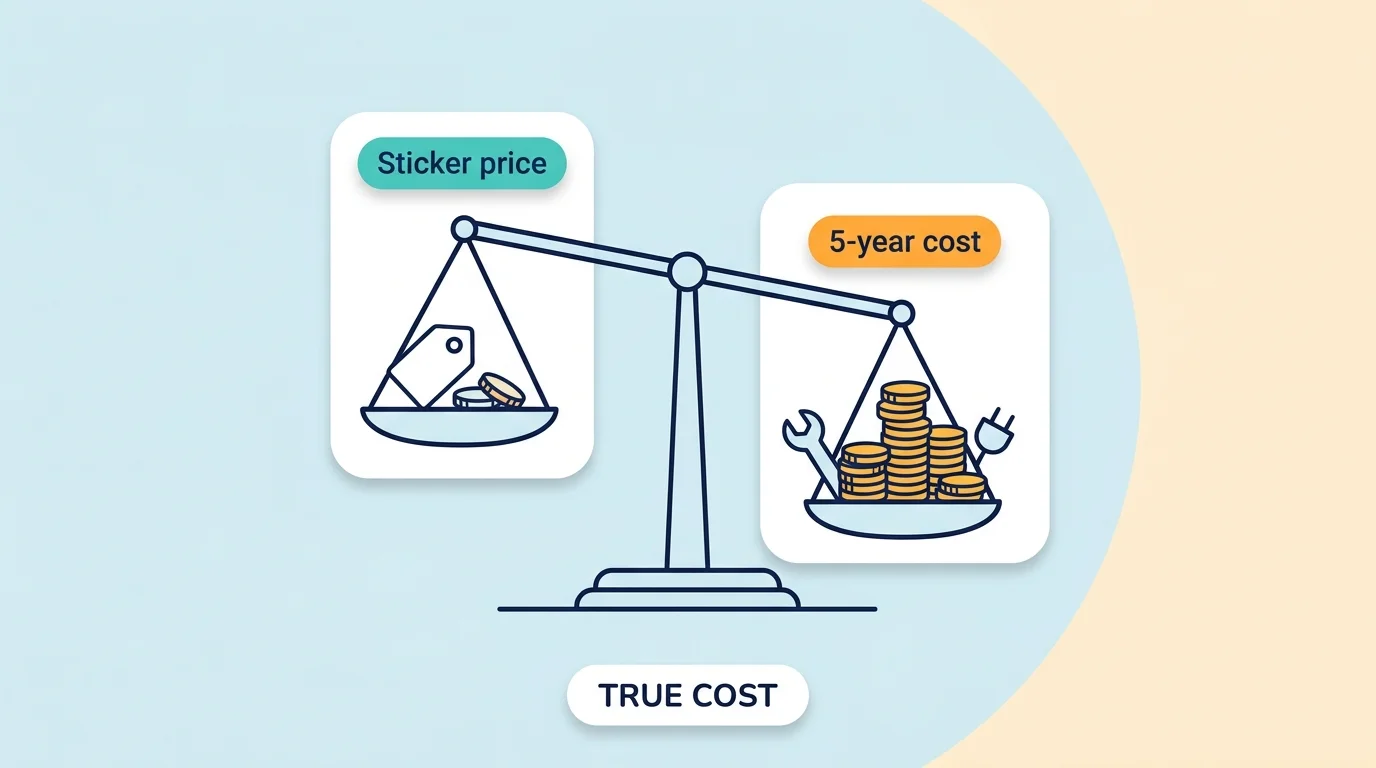
To compare the true cost of two products over five years, add up four things for each one: the price you pay today, the running costs after you buy (such as electricity, ink, refills, or subscriptions), the repairs and extras you will probably pay for, and then subtract what you could sell it for at the end. The product with the lower total is the cheaper one, even if its price tag is higher.
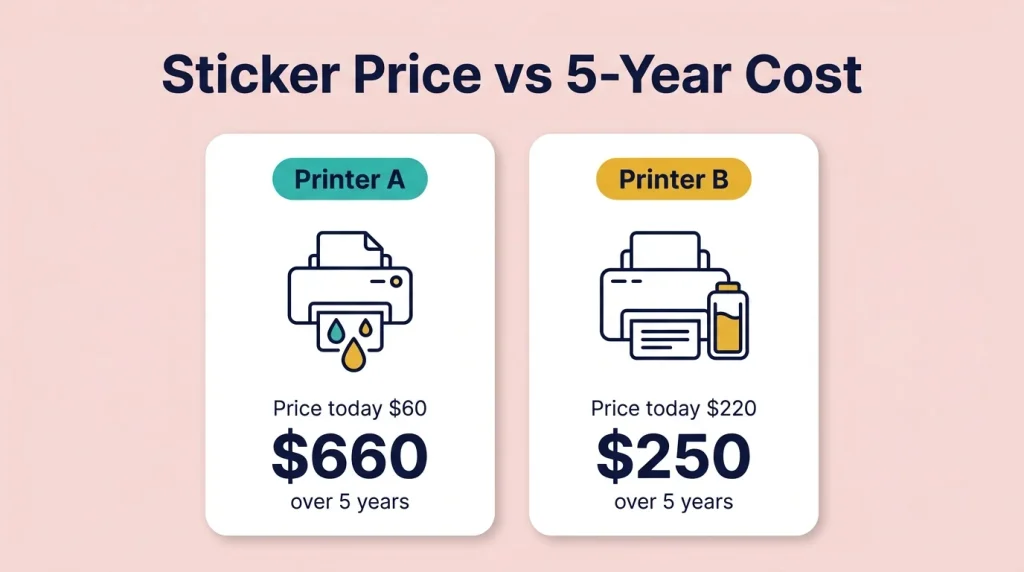
In one example below, with made-up but realistic numbers, a $60 printer ends up costing about $660 over five years, while a $220 printer costs about $250. The product with the lower price tag was the more expensive choice.
Most of us compare products by looking at the price on the shelf. That is understandable, but it only shows the first payment. This guide gives you a simple formula, two worked examples, a six-step method, and a list of costs that people often forget. It works for almost anything you buy, in any country, and all you need is a pen or a notes app.
Why Is the Price Tag Not the Real Price?
Think about a razor that costs very little but needs expensive blades. The razor is cheap. The shaving is not. Many products work this way. A low price gets you in the door, and the money comes later from refills, power, parts, or monthly plans.
Even products without refills have costs that arrive after you buy. A big appliance uses electricity every day for years. A phone needs a case, a charger, and sometimes a repair. A smart camera may only save video if you pay a monthly fee. None of this shows up on the price tag.
That is why one product can look like a bargain on day one and a poor choice by year three. A five-year view lets you see the full picture before you pay.
The Simple Formula
Here is the whole idea in one line:
True cost = price today + running costs + repairs and extras – resale value
Let us look at each part in plain words.
- Price today: what you pay at checkout, including tax, delivery, and any setup or installation.
- Running costs: anything you pay again and again to keep using it, such as electricity, ink, filters, refills, and subscriptions.
- Repairs and extras: costs you can expect over time, such as a replacement battery, a case, or a repair after the warranty ends.
- Resale value: what you could realistically sell it for at the end. Many everyday items are worth very little, so only subtract this when you know you will sell it.
Once you have the total, divide it by the number of years you expect to use the product. That gives you a cost per year, which makes two different products easy to compare.
Costs People Forget, by Product Type
Different products hide different costs. The table shows the usual extras and a question to ask before you buy.
| Product | Costs That Come After You Buy | Question to Ask |
|---|---|---|
| Printer | Ink or toner, paper | How many pages does one cartridge print, and what does it cost? |
| TV or monitor | Electricity, streaming apps, wall mount | How many watts does it use? |
| Phone | Case, charger, repairs, battery, monthly plan | How long will it keep getting updates? |
| Large appliance | Electricity, water, filters, repairs | What does the energy label say it uses per year? |
| Smart home gear | Monthly plan for video or cloud storage | Which features stop working without a subscription? |
| Software or apps | Yearly renewals, price rises | What will it cost in year two and year five? |
If a product comes with a subscription, such as a phone plan, a smart camera, or software, those small monthly fees are the easiest cost to forget. They pile up quietly, which is what we explain in our guide to subscription creep. Check the price in year two and year five, not just in the first month.
Worked Example: Two Printers
These numbers are made up to show how the method works. Real prices will differ, so use your own.
Printer A is cheap but uses small cartridges. Printer B costs more but has refillable ink tanks. Both print 600 pages a year.
| Printer A (Cheap) | Printer B (Ink Tank) | |
|---|---|---|
| Price today | $60 | $220 |
| Ink needed per year | 3 cartridges at $40 each | About 0.4 of a $15 bottle |
| Ink cost per year | $120 | $6 |
| Ink cost over 5 years | $600 | $30 |
| True cost over 5 years | $660 | $250 |
The assumptions are simple. Printer A prints about 200 pages per cartridge, so 600 pages needs 3 cartridges. Printer B prints about 1,500 pages per bottle, so 600 pages uses 0.4 of a bottle. Printer B saves about $410 over five years, even though it costs $160 more today.
Notice what happened. The cheap printer was the better deal for the first year only. By the second year, the ink had already cost more than the price difference. The method also tells you when the cheap one is right. If you only print a few pages a year, ink is a small cost, and the cheaper printer may win.
Worked Example: When the Pricier Product Does Not Win
This method does not always favor the more expensive choice. Here is a case where the cheaper product wins. Again, the numbers are made up, and the electricity price is $0.15 per kWh, so replace it with the price on your own bill.
TV A costs less but uses more power. TV B costs more and uses half the power. Both are watched for 4 hours a day.
| TV A | TV B | |
|---|---|---|
| Price today | $400 | $550 |
| Power use | 120 watts | 60 watts |
| Energy per year | About 175 kWh | About 88 kWh |
| Electricity cost per year | About $26 | About $13 |
| Electricity cost over 5 years | About $131 | About $66 |
| True cost over 5 years | About $531 | About $616 |
The saving on electricity is real, but it is only about $65 over five years. The extra $150 you pay for TV B is much bigger than that. In this case, TV A is the cheaper choice by about $85, unless TV B has a better picture or lasts longer.
The lesson is to check the right costs for each product. Ink is a big deal for printers. Electricity is a small deal for a TV. The method shows you which one matters.
Why Lifespan Changes the Answer
A product that wears out sooner has to be bought again, and that cost belongs in your five-year total.
Here is a simple made-up example. A $30 kettle lasts two years. A $60 kettle lasts six years. The cost per year of life is $15 for the first and $10 for the second. Over six years, you would buy three of the cheap kettles for $90, compared with $60 for one better kettle.
You do not need exact numbers. A rough guess is enough. Look at reviews for how long a product tends to last, check the length of the warranty, and ask whether parts can be repaired. If the product cannot be fixed and breaks easily, add a replacement to your total.
A 6-Step Method You Can Use for Any Purchase
- Pick two products and a time frame. Five years works for most appliances and electronics. Use two or three years for things that age fast, like phones, and eight to ten for things that last, like a fridge.
- Write down the price today. Include tax, delivery, and any setup. This is your starting number for each product.
- List the costs that come after you buy. Think about energy, ink or filters, subscriptions, repairs, and extras that the product needs to work.
- Put real numbers on them. Check the label, the box, and independent reviews. Use your own electricity price from your bill, and be careful with claims from the maker, since they may be best-case numbers.
- Subtract resale value only if you will sell. Be honest about it. If you usually keep things until they break, leave it out.
- Compare the totals and the cost per year. Pick the one with the lower number, unless something else matters more, such as comfort, safety, or how much you enjoy using it.
For a quick check, write both products side by side on one page. Seeing the two totals next to each other makes the answer much clearer than comparing prices in your head.
Common Mistakes People Make
Most mistakes come from skipping a step or guessing too much.
- Only looking at the price tag. It shows the first payment, not the whole cost.
- Overestimating how much you will use it. A pricey tool bought for a job you do twice a year rarely pays off. Be honest about how often you will use it.
- Ignoring how long it will last. A cheap product that breaks early can cost more than a better one.
- Forgetting parts that only the maker sells. If you can only use the maker’s own refills or accessories, those prices belong in your total.
- Trusting every number on the box. Claims about pages per cartridge or energy use are often best-case figures. Check independent reviews when you can.
- Letting the numbers decide everything. The cheapest total is not always the best choice. Comfort, safety, and quality matter too, so use the numbers as one input.
Frequently Asked Questions
What is the true cost of a product?
The true cost is everything you pay for a product over the time you use it, not just the price at checkout. It includes running costs, repairs, and extras, minus what you could sell it for. Some people call it the total cost of ownership.
How do I calculate the cost of a product over 5 years?
Add the price today, the running costs for five years, and the repairs and extras you expect. If you plan to sell it, subtract a realistic resale price. Then divide by five to get a cost per year.
Is the cheaper product ever the better buy?
Yes, very often. In the TV example above, the cheaper TV was the better deal because power use was a small part of the total. The method helps you see which costs matter for each product.
Should I always use five years?
No. Five years is a good middle point for many products. Use a shorter time for items that age quickly, like phones, and a longer one for things that last, like large appliances.
Should I include resale value?
Only if you really plan to sell it and you know what similar items sell for. Many everyday items are worth very little after a few years, so it is safer to leave it out when unsure.
Which costs do people forget most?
Subscriptions, accessories, refills, and replacements. These are easy to miss because they arrive later, in small amounts, after you have already bought the product.
Check One Price Tag This Week
Think of something you plan to buy, or something you bought last year, and work out its true cost on paper. It only takes about ten minutes.
Even one rough calculation changes how you look at price tags afterward. You may find that the cheaper product really is the cheaper one, and that is still a good result, because now you know why.