

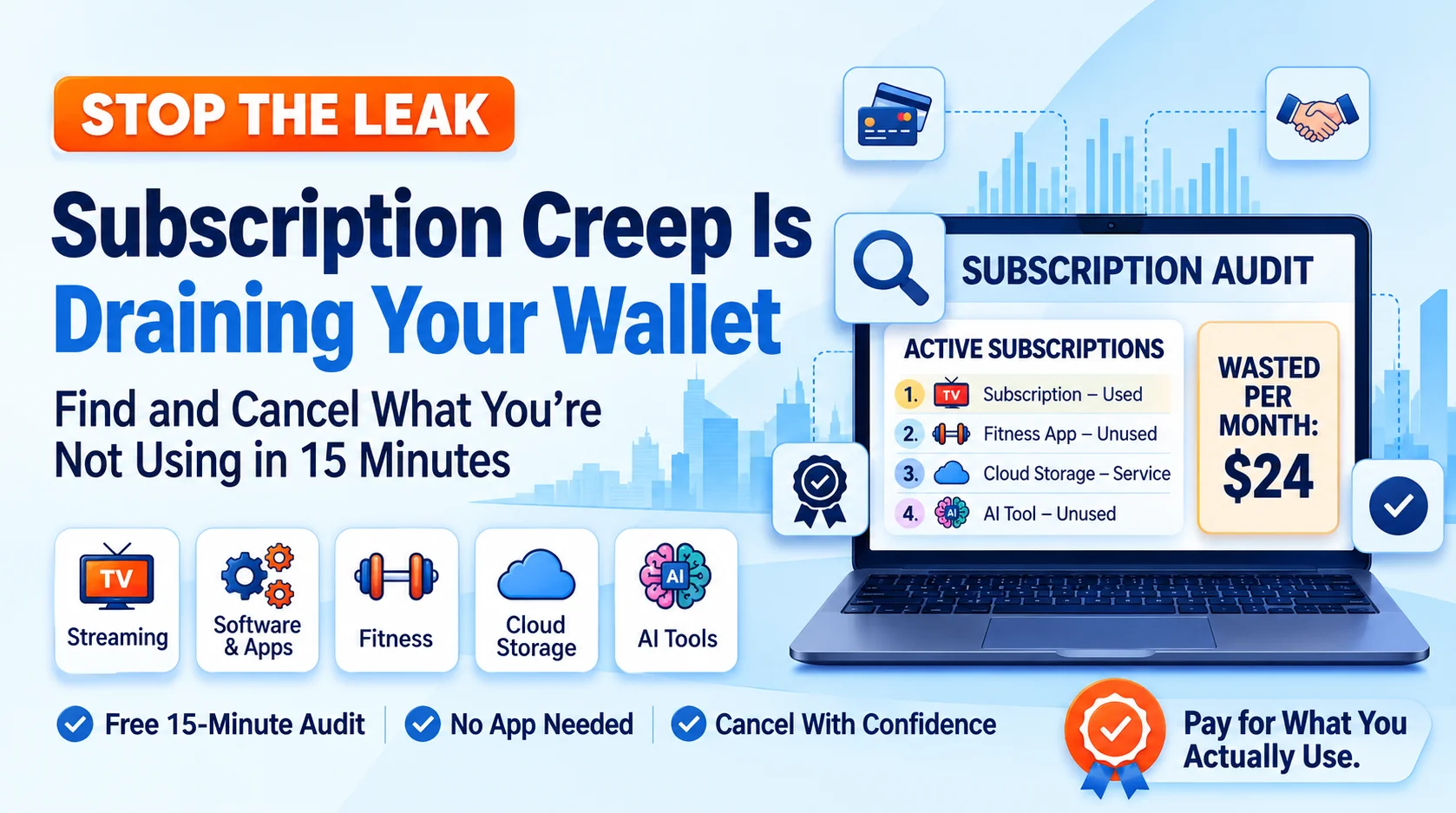
Subscription creep is the slow, almost invisible buildup of paid subscriptions that happens when signing up feels effortless but canceling never quite makes it to the top of your to-do list. Most people are not overspending because of one big purchase. They are overspending because of a dozen small, recurring charges that individually feel harmless but add up to a real amount of money every single month.
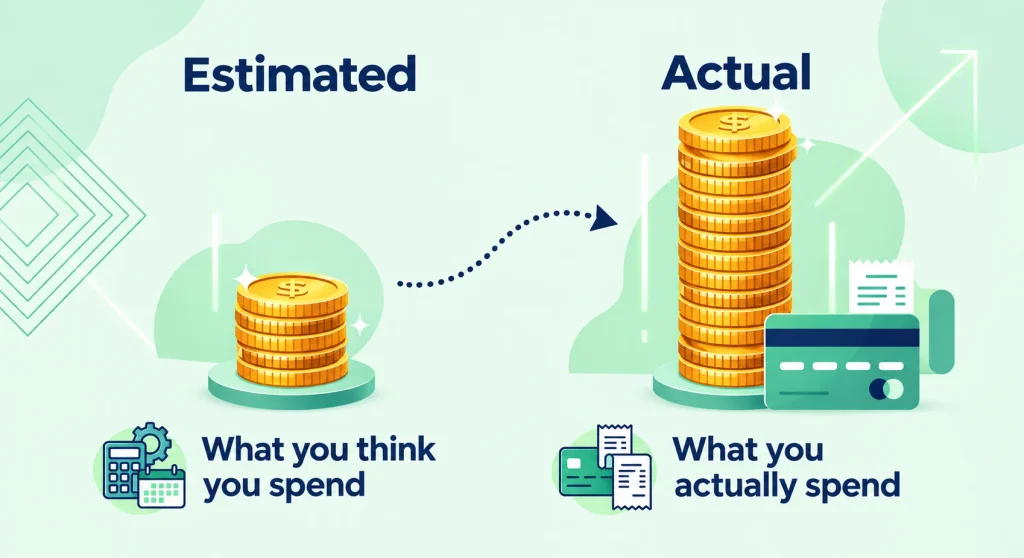
Recent research backs this up clearly. The average household now spends around $273 a month on subscription services, and roughly 89 percent of people underestimate their own actual spending, often by more than $200 a month. This is not a small oversight. It is a pattern happening to nearly everyone, and it is fixable once you know where to look.
Subscription creep happens gradually, which is exactly why it is so easy to miss. It usually starts small: a free trial that quietly converts into a paid plan, a streaming service kept “just in case” after a show ends, or a fitness app subscription from a New Year’s resolution that never got canceled once the motivation faded.
None of these decisions feel significant in the moment. Signing up takes seconds, and most subscription charges are small enough that they do not register as a real expense the way a big one-time purchase would. But subscriptions are designed to be recurring by nature, and that is precisely what makes them accumulate so quietly over time.
The subscription model itself has also expanded far beyond where it started. A decade ago, most people had maybe two or three recurring charges: cable, maybe a gym membership, and a phone plan. Today, nearly every category of product has shifted toward a subscription, software, entertainment, meal kits, razors, even mattresses and car washes. Each one on its own feels like a reasonable convenience. Stacked together, they quietly become a second rent payment nobody budgeted for.
The gap between what people think they spend and what they actually spend is one of the clearest signs of how easily this adds up.
| Metric | Reported Figure |
|---|---|
| Average household monthly subscription spending | About $273 |
| People who underestimate their own spending | 89 percent |
| People off by more than $200 a month | 66 percent |
| Average number of unused subscriptions per person | 2.6 |
| Monthly value of unused subscriptions | Around $21 to $27 |
That last figure alone, roughly $21 to $27 a month wasted on subscriptions people are not even using, adds up to $250 to $325 a year in pure waste. Not money spent on something you enjoy, just money spent on something you forgot to cancel.
It is also worth noting that these numbers have been climbing, not staying flat. Year over year tracking shows average subscription spending rising steadily, even as individual services have not necessarily gotten more expensive. The growth comes mostly from stacking, adding new subscriptions faster than old ones get canceled, rather than any single service raising its price dramatically.
There is a simple psychological reason this keeps happening. A single $9.99 monthly charge feels almost painless. Compare that to spending $120 in one transaction, and the $9.99 monthly version will always feel smaller, even though twelve months of it adds up to the exact same amount.
Subscriptions also tend to spread across many different payment methods and billing dates, which makes it hard to see the full picture in one place. A streaming service might bill through Apple, a fitness app might charge directly to a debit card, and a cloud storage plan might renew annually instead of monthly, which makes it easy to forget entirely until the charge appears once a year.
Subscription creep is not limited to the obvious streaming services most people think of first.
This category is worth watching closely going forward. Because AI tools are new and exciting, it is easy to sign up for several at once to compare them, fully intending to cancel the ones you do not end up using. In practice, that follow-through rarely happens as reliably as planned, which makes AI subscriptions one of the fastest-growing sources of subscription creep right now.
You do not need special software to get a clear picture of what you are actually paying for. A focused 15-minute audit is usually enough.
That’s the whole process. No app to download, no account to create, just an honest look at what’s actually leaving your account every month. Most people are surprised by at least one subscription they’d completely forgotten was still active
Catching existing subscription creep is only half the fix. Preventing it from quietly returning takes a couple of small habit changes.
None of these habits require tracking every purchase obsessively or giving up conveniences you genuinely value. The goal is not to eliminate subscriptions entirely, plenty of them are worth every dollar. The goal is making sure every subscription on your statement is there because you actively chose it, not because canceling it simply never made it to the top of your list.
Subscription creep is the gradual, often unnoticed buildup of multiple paid subscriptions over time, usually because canceling unused ones gets put off while new ones keep getting added.
Recent research puts the average household subscription spending at around $273 a month, spanning streaming, software, fitness, food delivery, and other recurring services.
Small individual charges feel less significant than one larger purchase, even when they add up to the same total. Subscriptions also spread across different payment methods and billing cycles, making the full picture harder to see at a glance.
Every three months is a reasonable habit. Needs and usage patterns change faster than an annual review can catch, especially with free trials and app subscriptions.
If the service offers a pause option and you have a genuine plan to use it again soon, pausing can make sense. Otherwise, canceling is usually the safer default, since it is easy to resubscribe later if you actually need it again.
In some ways, yes. Annual plans are billed only once a year, which makes them easy to forget about entirely until the renewal charge appears. A subscription that renews annually deserves its own reminder well before the renewal date, precisely because it will not show up on your radar the way a monthly charge would.
Most people are not overspending on purpose. They are overspending because small charges are easy to forget and hard to see all in one place. A 15-minute audit today can uncover money you did not realize you were losing every single month, and a few simple habits can keep it from quietly building back up.
The households that stay ahead of subscription creep are not the ones who never sign up for anything new. They are the ones who check in regularly, ask honestly whether something is still worth paying for, and treat a subscription list the same way they would any other recurring bill, something worth reviewing on purpose, not just letting run in the background indefinitely.


Comments are off for this post.