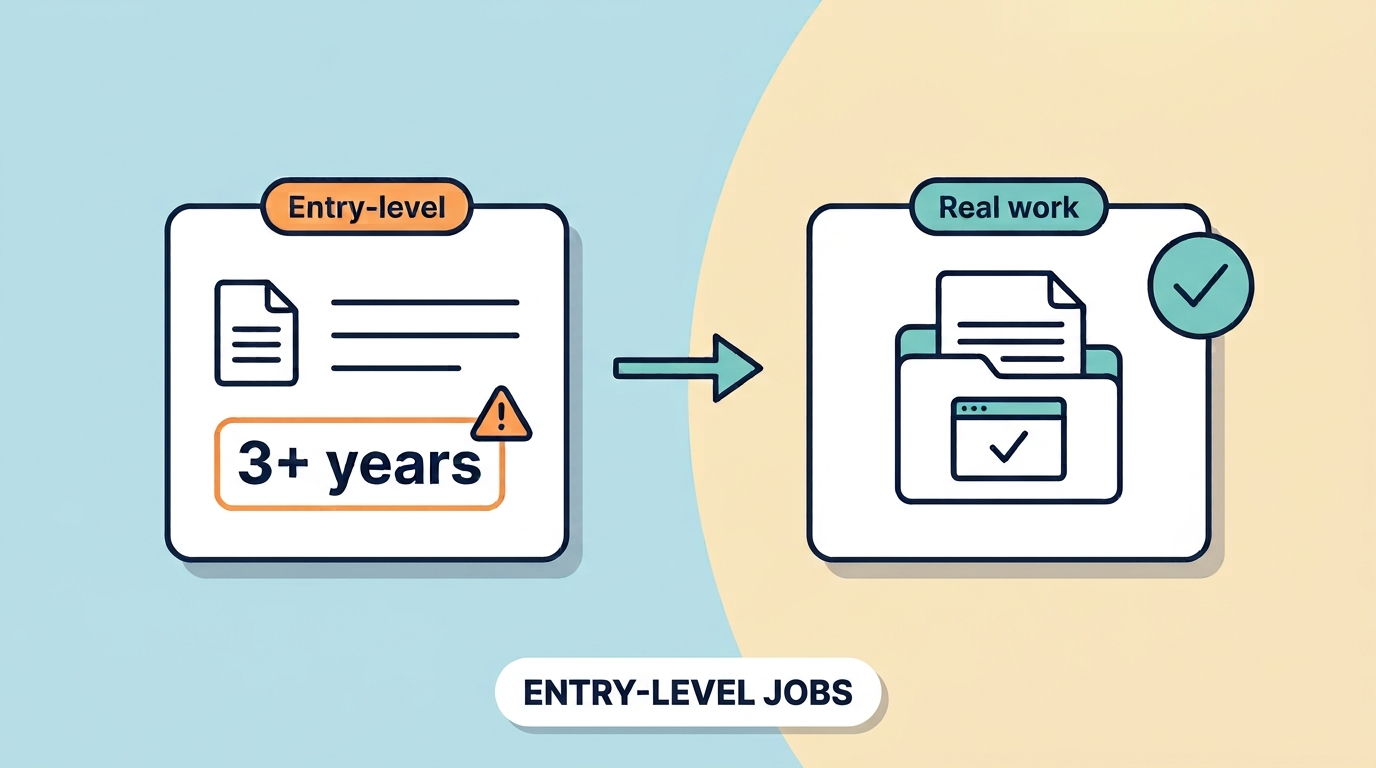
Entry-level jobs ask for so much because job posts often list everything a manager wishes for, employers want to avoid a bad hire, and AI now does many of the basic tasks that used to train beginners. You can still stand out by showing proof of real work, not years of experience.
In a June 2026 survey of more than 1,000 US hiring managers, ZipRecruiter’s 2026 AI Employer Report found that 38 percent of employers had moved basic data entry and processing to AI, and 31 percent had raised experience requirements for entry-level roles. This guide explains what that means and gives you a five-step plan to build proof before you apply.
What Is Really Going On Behind the Job Post?
A job post is not always a strict rulebook. Three forces sit behind it.
- Wish lists. Many posts describe the perfect person, not the minimum. A manager writes down everything that would be nice to have, and the result looks like a senior job with a junior title.
- Risk. Hiring a beginner costs time and money, and employers worry about picking the wrong person. Asking for experience feels safer, and when many people apply, it is an easy way to shrink the pile.
- AI is taking the starter tasks. Work like basic data entry and processing used to teach beginners how a company runs. As AI takes more of it, employers expect new hires to start with more skill and to do more valuable work sooner.
None of this is fair to beginners. But once you know why it happens, you can respond to it in a smarter way.
What the Research Says
These are the main numbers from the ZipRecruiter 2026 AI Employer Report.
| What We Know | The Numbers |
|---|---|
| Employers using AI at some level | 92 percent (ZipRecruiter, 2026) |
| Employers who raised baseline productivity expectations because of AI | 57 percent (ZipRecruiter, 2026) |
| Employers who moved basic data entry and processing from entry-level workers to AI | 38 percent (ZipRecruiter, 2026) |
| Employers who raised experience requirements for entry-level roles because of AI | 31 percent (ZipRecruiter, 2026) |
| Posts labeled entry-level that asked for years of related experience | About 35 percent (analysis of close to 4 million LinkedIn posts, reported in 2021) |
Be careful with these numbers. The ZipRecruiter figures come from a survey of more than 1,000 US hiring managers in June 2026, and ZipRecruiter is a job marketplace. They show what employers said, not an exact count of jobs, and they may look different in other countries or fields. The problem is also not new. A 2021 analysis of close to 4 million LinkedIn job posts, reported by BBC Worklife, found that about 35 percent of “entry-level” postings asked for years of prior relevant experience.
The same ZipRecruiter report describes AI as more of a growth engine for hiring than a job killer. But it also found that 31 percent of employers raised experience requirements for entry-level roles. In plain words, jobs still exist, but beginners are expected to show more.
How to Read a Job Post Without Panic
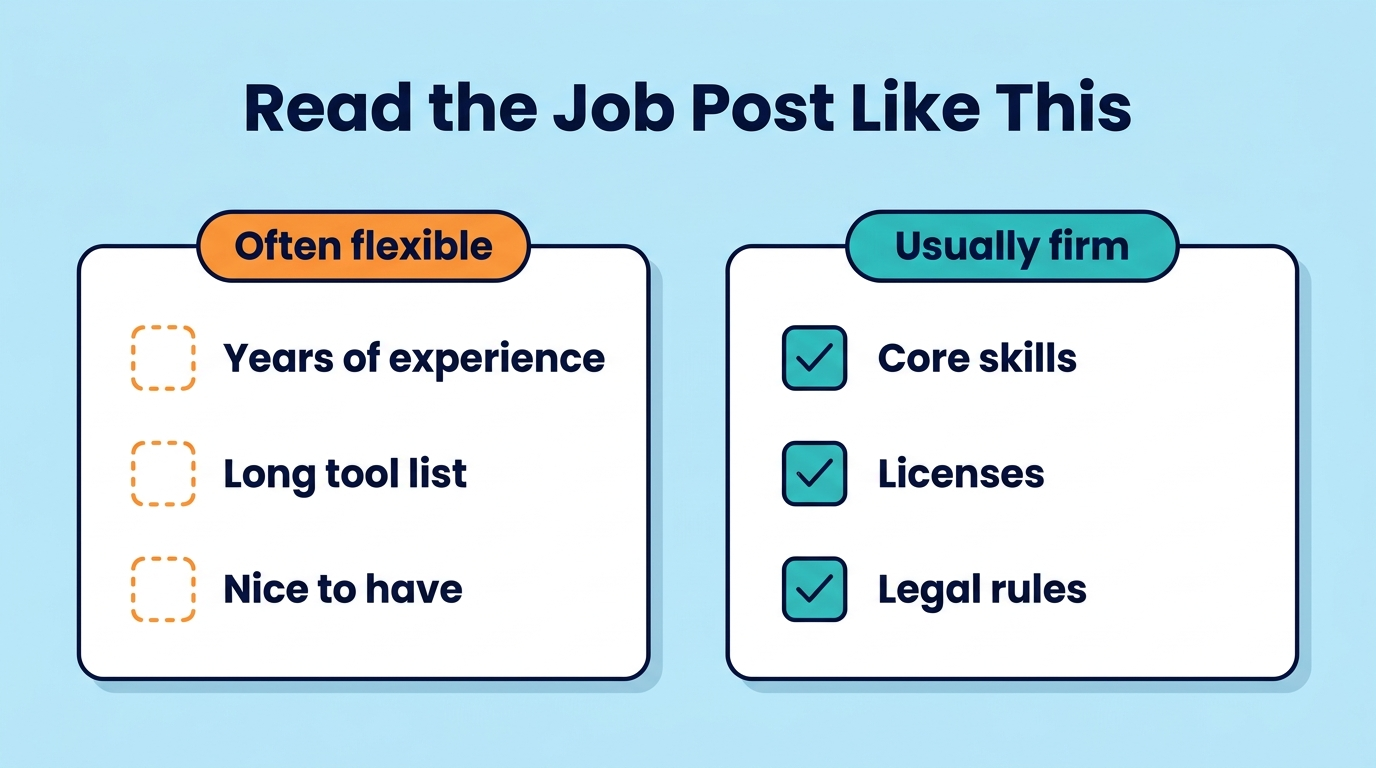
Not every line in a job post carries the same weight.
Often flexible:
- Years of experience, especially when the role is called entry-level
- Long lists of tools and programs
- Lines that say preferred or nice to have
Usually firm:
- Licenses and legal requirements
- Required languages
- Core skills the job cannot work without
A good rule is this: if you can do most of the core work, apply, and use your resume and a short message to show proof. This is not a guarantee. Some employers use automatic filters that follow the number strictly, which is exactly why proof of real work matters.
What Counts as Experience When You Have No Job?
More things count than most beginners think. Employers mainly want to know that you can do the work.
- Projects. Something you built, wrote, designed, or solved from start to finish.
- Freelance or small paid tasks. Even a few jobs count. Our list of free resources for freelancers can help you get started.
- Internships and volunteering. Real work for a real group of people, even for a short time.
- Course work with real output. A report, a case study, or a dashboard you made. A certificate alone shows less than something you can open and look at.
- Something you run yourself. A small blog, a shop, a community, or a channel shows that you can start and keep going.
What makes any of these count is a clear result you can point to and explain in two sentences.
A 5-Step Plan to Stand Out
You do not need years of experience to look ready. You need proof that you can do the work. These five steps take you from reading job posts to sending an application with a real example attached.
Step 1: Pick one target role and read ten job posts for it
Write down the skills that show up in most of them. Those are the real requirements. One-off lines are usually wish list items.
Step 2: Build one small project that uses those skills
Keep it small enough to finish in two to four weeks. If you need to learn the basics first, see our guide to the best online learning sites. Here are starting ideas:
| Target role | Project idea |
|---|---|
| Digital marketing | Run a small social page or blog for six weeks and report follower and traffic growth |
| Data or analyst | Clean a public dataset and build a one-page dashboard that answers one question |
| Admin or operations | Build a spreadsheet system that tracks tasks, deadlines and costs for a small group |
| Web development | Build and publish a simple site for a local shop, club or your own portfolio |
| Writing or content | Write three articles on one topic and show the search or reader results |
Step 3: Learn how AI fits into the role
Use AI tools for first drafts, sorting, or research, and always check the output yourself. Our guide on how to identify which parts of your job AI can automate shows how to sort tasks into what AI can do and what you keep.
Step 4: Write your proof into your resume
Replace lines like “responsible for” with results: what you made, how long it took, and what changed. Add a link to the work.
Before: Responsible for social media posts.
After: Grew a test Instagram page from 0 to 400 followers in 6 weeks using a 3-post weekly plan. Link: [your link]
Use your own real numbers. If you do not have numbers yet, describe the result in plain words, such as “Wrote 3 blog posts and got 200 reads in the first month.”
Step 5: Apply with a short message and a link
Two or three sentences are enough: why this role, one piece of proof, and the link. Apply even if you miss one or two requirements, as long as you meet the core ones. Fill in the brackets with your own details, and change the wording to sound like you:
I’m applying for the [role] because [one reason]. I recently built [project] that [result], which you can see here: [link]. I’d be glad to talk about how I’d bring the same approach to your team.
Common Mistakes People Make
Most beginners lose chances in the same few ways.
- Skipping a job because of one requirement. If you meet the core skills, a missing year or tool is often not a deal breaker.
- Collecting certificates without projects. A certificate says you learned something. A project shows you can use it.
- Letting AI write everything. Employers can tell, and mistakes in your resume or project hurt more than they help. Use AI to help, then check and rewrite in your own words.
- Sending the same long resume everywhere. Match your top skills and proof to each role.
- Waiting until you feel ready. You will rarely feel fully ready. A finished small project is better than a perfect plan.
- Ignoring small opportunities. Volunteering, short tasks, and personal projects all build proof.
Frequently Asked Questions
Why do entry-level jobs ask for experience?
Often because the post is a wish list, because employers want to lower the risk of a bad hire, and because AI now handles some of the basic tasks that used to train beginners. In a 2026 ZipRecruiter survey, 31 percent of employers said they had raised experience requirements for entry-level roles.
Should I apply if I do not meet all the requirements?
Often yes, if you meet the core requirements and can show proof of real work. It is not a guarantee, since some employers use strict filters, but many posts list more than the job truly needs.
How can I get experience with no job?
Build a small project, take on a few freelance tasks, volunteer, or run something yourself, such as a blog or a small shop. Pick work that gives you a clear result you can show.
Is AI taking entry-level jobs?
It is taking some basic tasks, and expectations are rising. The ZipRecruiter report found that 38 percent of employers had already moved basic data entry and processing to AI, but it also describes AI as more of a growth engine for hiring than a job killer. The effect depends on the field, so check what employers in your own field are asking for.
Do certificates count as experience?
They help show that you learned something, but a project proves you can do the work. The best approach is both: use a course to learn, then make something with it.
How long does it take to build proof?
A small project can take two to four weeks. The goal is to finish it and show a result, not to make it perfect.
Build One Piece of Proof This Month
Choose one role you want, read ten job posts for it, and decide on one small project that uses the skills they share. You do not need to fix your whole career today.
A single finished project with a clear result will do more for your next application than another line about being a fast learner.