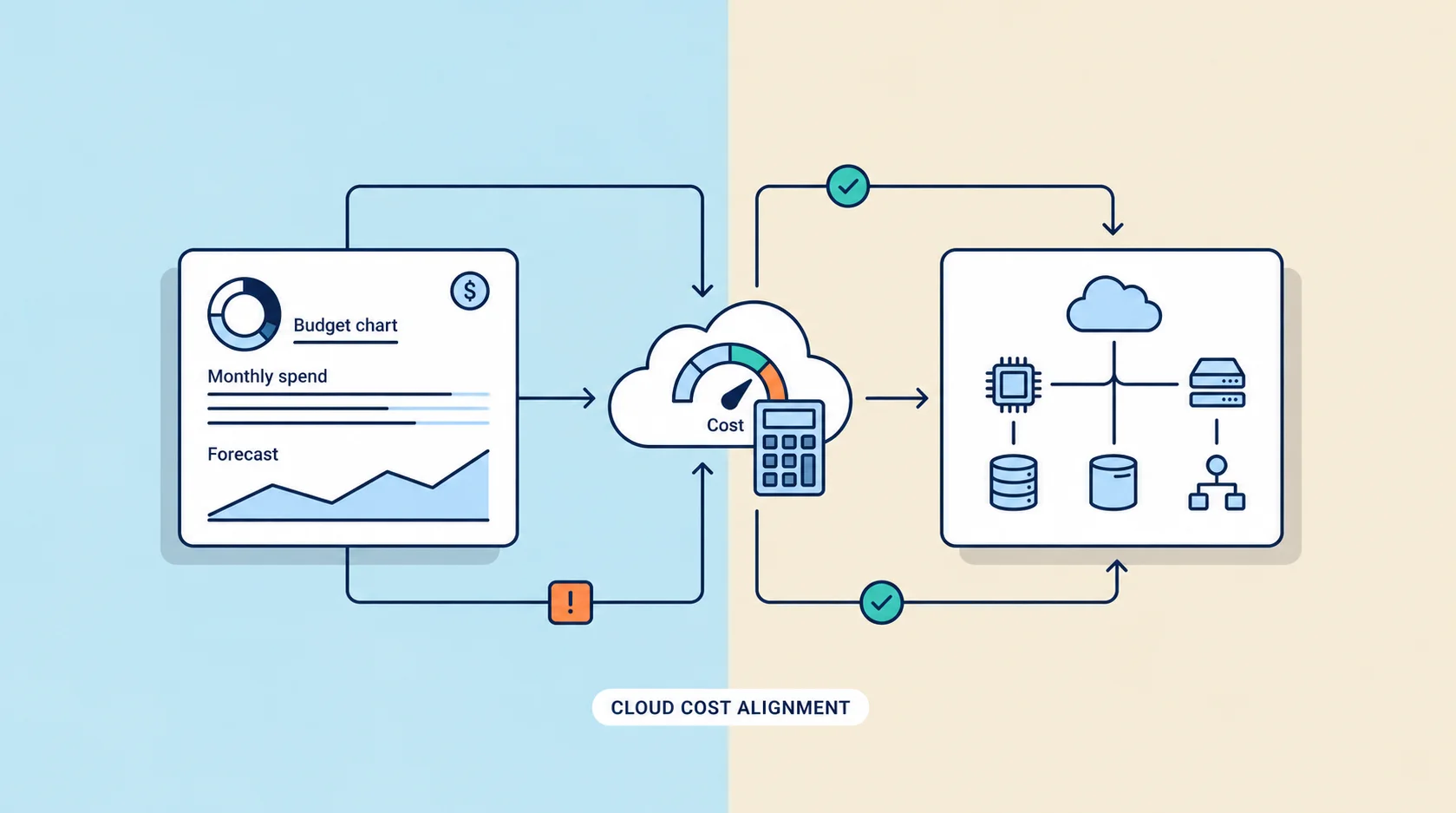
FinOps is a simple idea with a complicated-sounding name. It means bringing finance people and engineering people together to make smart decisions about cloud spending, instead of finance finding out about a huge bill after it already happened, and engineers never seeing the cost of what they build.
The word itself is just “Finance” and “Operations” mashed together. That is really all it is. It is not a tool you buy, and it is not a single person’s job. It is a way of working where cost becomes something the whole team thinks about together, the same way they already think about speed, reliability, or security.
If this sounds like common sense, that is because it is. What makes it worth naming and talking about is how often companies get it wrong without realizing it. Cloud spending is easy to lose track of precisely because it grows quietly, one small service at a time, until the total becomes a surprise instead of something anyone planned for.
What Does FinOps Actually Mean?
FinOps means making cloud costs visible, understandable, and shared across a team, instead of hidden inside one department’s dashboard that nobody else ever looks at.
In a normal company without FinOps, this is roughly what happens: engineers build and deploy things in the cloud, and they rarely see what any of it costs in real time. Finance sees the bill once a month, usually after the spending already happened, with no easy way to tell which team or project caused it. Nobody finds out there was a problem until the invoice is already due.
FinOps fixes that gap. It gives everyone, not just finance, a clear, shared view of what is being spent and why, so decisions about cost happen while something is being built, not weeks later when it is too late to change anything.
Why Companies Are Adopting FinOps Now
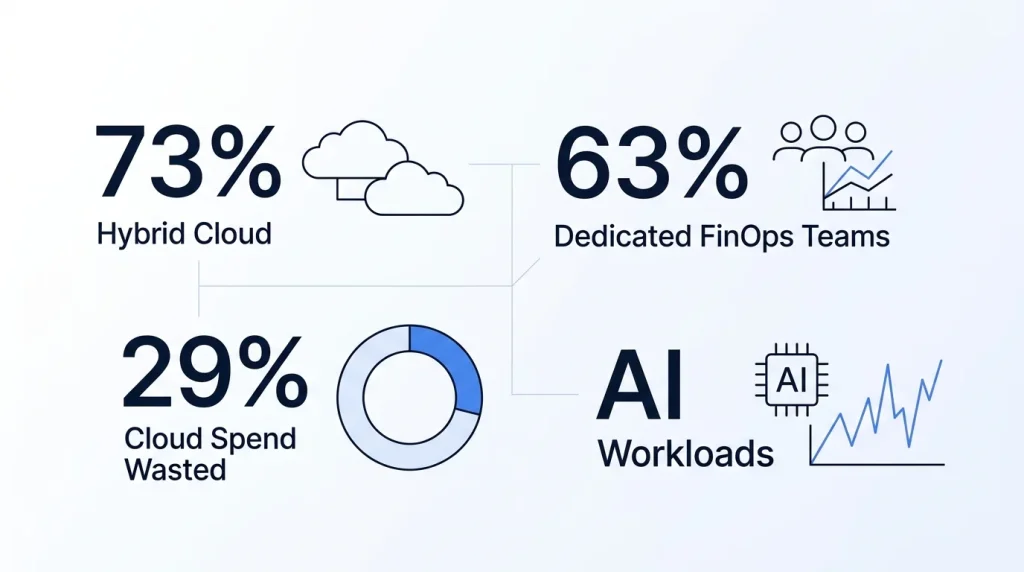
This is not a small or niche trend. Recent industry data shows just how fast this shift is happening.
| What’s Changing | The Numbers |
|---|---|
| Companies running cloud across more than one provider | 73 percent now operate a hybrid setup |
| Companies with a dedicated FinOps team | 63 percent, up sharply from recent years |
| Estimated wasted cloud spending | Around 29 percent of total cloud budgets |
That last number is the one that matters most. Nearly a third of what companies spend on cloud services is estimated to be wasted, not because anyone is being careless on purpose, but because nobody has a clear, shared picture of where the money is going. As more companies spread their workloads across multiple cloud providers, keeping track of spending by hand becomes nearly impossible, which is exactly why FinOps has grown from a niche practice into something companies are actively building teams around.
There is also a newer factor pushing this trend forward: AI workloads. Running AI models and tools often comes with spending that changes a lot from month to month, depending on usage, instead of staying steady and predictable like a traditional server bill. That kind of unpredictable, usage-based cost is exactly the type of problem FinOps habits are built to catch early, rather than discovering it after a particularly expensive month has already passed.
The Three Core Ideas Behind FinOps
You do not need to memorize a framework to understand FinOps. It really comes down to three simple habits, done on a repeating cycle rather than once a year.
See it. Before you can manage cloud costs, you need to actually see them clearly, broken down by team, project, or feature, not just one giant number at the bottom of an invoice.
Improve it. Once costs are visible, the next step is finding the obvious waste. This might mean shutting down something nobody is using anymore, or choosing a cheaper option that does the exact same job.
Keep doing it. FinOps is not a one-time cleanup. It is a habit of checking in regularly, since new costs appear every time something new gets built or deployed.
Together, these three habits form a simple, repeating loop: look at spending, fix what’s wasteful, then check again next month, rather than treating cost control as a one-time project that’s finished once and forgotten.
Who Is Actually Responsible for FinOps?
This is one of the most common points of confusion, and the honest answer is: it is not just one person’s job.
In companies that do this well, finance brings visibility into spending patterns and budget goals. Engineers bring the technical knowledge of what is actually running and why. Leadership helps connect spending decisions to what the business actually needs to prioritize. None of these groups can do FinOps alone, which is exactly why it is described as a cultural practice, not a department.
For smaller teams or individual site owners, this can feel like overkill. It is not. Even a team of one can apply the same basic idea: regularly check what you are spending on cloud services, understand why each cost exists, and cut what no longer earns its keep.
It also helps to drop the idea that cost control is somehow separate from building a good product. A feature that works well but quietly costs far more than it needs to is not actually a success, it is just a problem that has not been noticed yet. Thinking about cost from the start, rather than bolting it on later, tends to produce better decisions overall, not just cheaper ones.
Common FinOps Mistakes Small Teams Make
Larger companies are not the only ones who waste cloud spending. A few patterns show up again and again, even in small projects and side businesses.
- Checking costs only once a month, right when the bill arrives, instead of checking in more often while there is still time to catch a mistake early.
- Assuming the cheapest plan is automatically the best choice, without checking whether it actually fits the workload, sometimes a slightly pricier option avoids expensive overage charges later.
- Leaving unused resources running long after a project wraps up, simply because nobody assigned the task of shutting them down.
- Treating cost as someone else’s problem, usually finance’s, instead of something everyone building on the cloud shares responsibility for.
How to Start Thinking Like a FinOps Team, Even Without One
You do not need a dedicated team or expensive software to apply the core idea of FinOps to your own cloud spending.
- Set a recurring reminder to check your cloud costs, weekly or biweekly, not just once a month when the bill lands.
- Break your spending down by project or service, rather than looking at one combined total, so you can actually tell what is driving the cost.
- Estimate your costs ahead of time before deploying something new, rather than finding out the real number only after the fact.
- Review what’s actually still running, and shut down or downsize anything left over from a finished project.
- Treat it as a habit, not a one-time fix. A quick, repeated check catches small problems before they become expensive ones.
If you want a simple starting point for step three, our free AWS Cost Calculator lets you estimate real costs before you deploy anything, so you are planning ahead instead of reacting to a surprise bill later.
Frequently Asked Questions
What does FinOps stand for?
FinOps combines “Finance” and “Operations.” It describes the practice of bringing financial awareness directly into how teams build and run things in the cloud, rather than treating cost as a separate, after-the-fact concern.
Is FinOps only for large companies?
No. While large companies often build dedicated FinOps teams, the core habit, regularly checking and understanding your cloud spending, applies just as well to a small team or even a single person managing their own cloud projects.
How is FinOps different from just cutting costs?
Cutting costs is a one-time action. FinOps is an ongoing habit of visibility and regular review, so spending stays efficient over time instead of needing a big, painful cleanup every so often.
Do I need special software to practice FinOps?
Not necessarily. Many companies use dedicated FinOps tools as they scale, but the underlying habits, checking spending regularly, understanding what drives it, and estimating costs ahead of time, can be done with basic tools and a consistent routine.
Why is cloud waste so common even with careful teams?
Cloud costs are usage-based and spread across many small services, which makes it easy for spending to grow quietly in the background. Without a habit of checking in regularly, that gradual growth often goes unnoticed until the bill arrives.
Can one person practice FinOps, or does it require a whole team?
One person absolutely can. The habits, checking spending regularly, understanding what’s driving it, and cutting waste, work the same whether you’re a solo developer managing one project or part of a large team managing dozens. The scale changes, but the core habit does not.
Start Applying FinOps to Your Own Cloud Spending
You do not need a dedicated team or a big budget to think like a FinOps practitioner. The core idea is simple: see your spending clearly, fix what’s wasteful, and make checking in a regular habit instead of a yearly scramble.
If you are planning a new AWS project, estimate the real cost before you deploy anything using our free AWS Cost Calculator, so you start with a clear number instead of finding out the hard way.