


AI search engines like ChatGPT, Perplexity, and Google’s AI Overviews do not rank pages the same way traditional Google search does. Instead of showing a list of links, they read through content, pull out the clearest answers, and combine them into one summary for the person asking the question. Most content on the internet was never written for that. It was written to rank in a list, not to be picked out and quoted directly. That gap is exactly why so many well written, useful pages are being skipped over by AI search, even when they rank fine on regular Google.
The good news is that this is fixable, and it does not require rewriting your entire website. It just means understanding what AI tools are actually looking for, and adjusting how you present information so it becomes easy to lift out and use.
GEO is the practice of structuring content so AI powered search tools can easily extract, quote, and cite it in their generated answers. It is a newer idea that has grown alongside the rise of AI chat tools and AI powered search results.
Traditional SEO is mostly about ranking position. You want your page to appear as high as possible on a results page, so people click on it. GEO works differently. Instead of trying to be the link someone clicks, you are trying to be the actual source an AI tool pulls information from when it writes its answer. Sometimes that means the reader never visits your site at all, but your business or website still gets mentioned by name inside the AI’s response, which builds trust and awareness in its own way.
Both approaches matter today. Traditional SEO still drives real clicks and visitors. GEO is about making sure you are not left out of the growing number of searches that end with an AI generated answer instead of a list of links.
This shift matters more than it might seem at first glance. A growing share of people now ask an AI assistant a question directly instead of typing it into a search bar and clicking through several links. If your content is never picked up as a source for those answers, you are effectively invisible to that entire slice of your audience, even if your website itself is well built and ranks decently in regular search.
Most blog posts and articles online were built with older search habits in mind, and a few common patterns quietly work against them when an AI tool tries to use them as a source.
The first problem is the long introduction. Many articles spend two or three paragraphs setting the scene, telling a short story, or building up to the point, before actually answering the question. AI tools are not patient readers. They are looking for a clear, direct answer near the top of the page, and if it is buried under a long buildup, it often gets skipped in favor of a page that gets straight to the point.
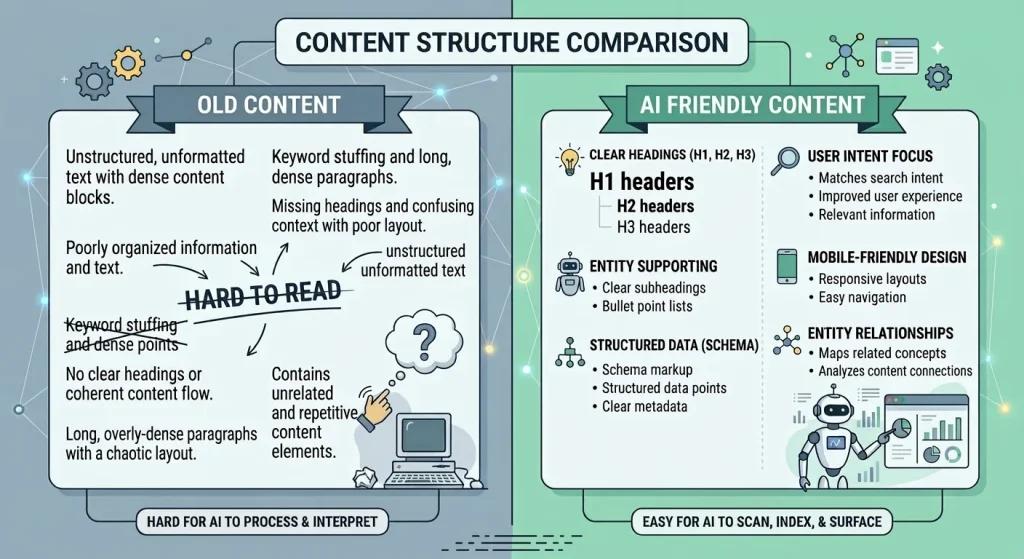
The second problem is structure. A page full of long, dense paragraphs with no headers, no bullet points, and no tables is much harder for an AI system to break down and use. Structured content, on the other hand, is easy to scan and easy to lift pieces from.
The third problem is missing trust signals. Pages with no clear author, no sources, and no real expertise behind them are treated with more caution, since AI tools are increasingly built to prefer content that shows real knowledge and credibility rather than content that could have been written by anyone about anything.
A fourth, smaller issue is phrasing. Many older articles were written to match short, choppy keyword phrases like “best internet plan cheap,” because that used to be how people typed into search engines. AI tools respond better to natural, full sentence questions, closer to how someone would actually speak out loud. Content that already reads naturally has an advantage here, while content written purely around old style keyword phrases can feel stiff and out of step with how questions are asked today.
Here is a simple side by side comparison of the difference:
| Traditional SEO Content | GEO Friendly Content |
|---|---|
| Long intro before the answer | Direct answer in the first 1 to 2 sentences |
| Wall of text paragraphs | Short paragraphs, bullet points, tables |
| Vague or missing authorship | Clear author and expertise signals |
| Keyword stuffing | Natural language matching how people actually ask questions |
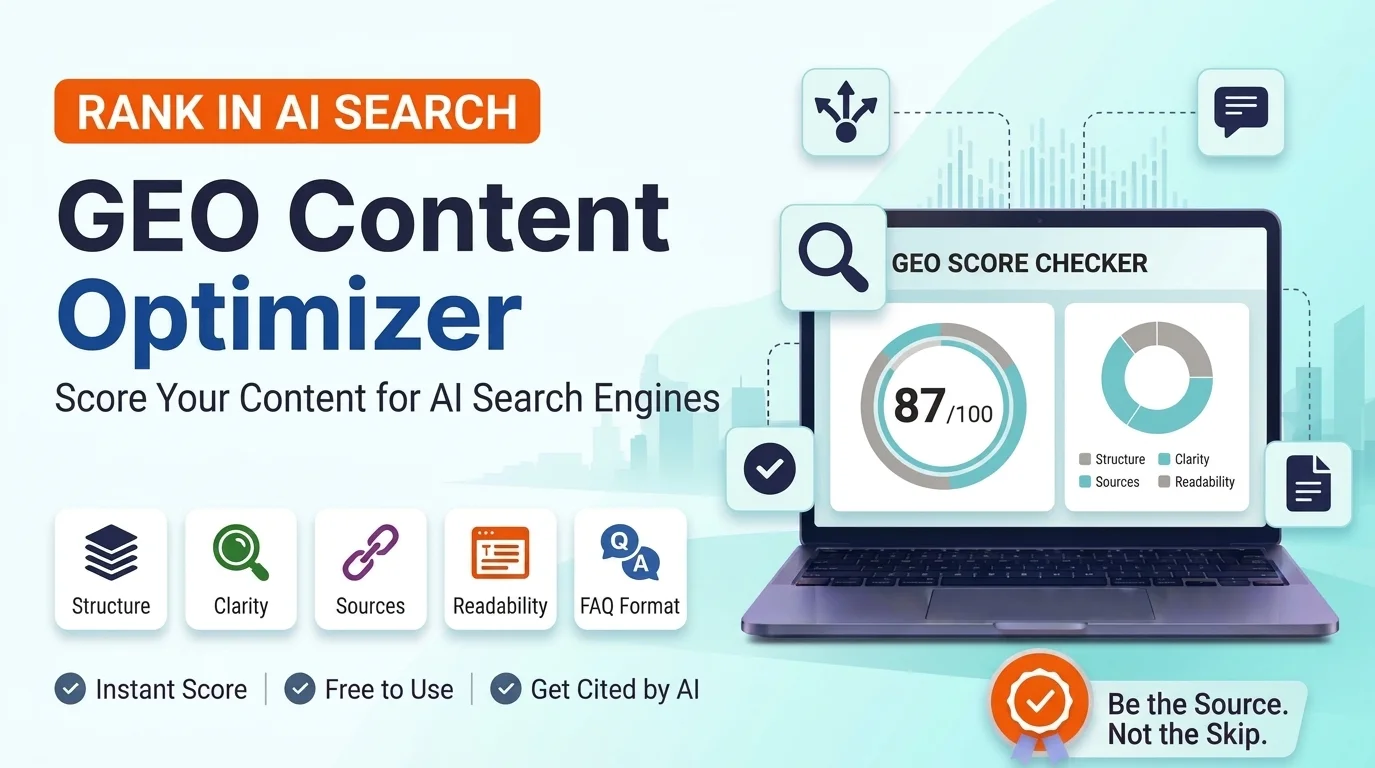
Reading through your own content and guessing whether it is GEO friendly is difficult, since it is hard to see your own writing the way an outside system would. This is exactly the gap our GEO Content Optimizer tool is built to close.
The tool looks at a piece of content and scores it across several key areas. It checks whether the main question is answered clearly near the top, whether the structure uses headers, bullet points, and tables in a way that is easy to extract from, whether the writing is easy to read at a glance, and whether there is enough factual detail to feel trustworthy rather than vague. Instead of guessing, you get a clear score along with specific suggestions on what to fix first.
This is especially useful before you publish something new, but it is just as valuable for older articles that may already be losing visibility in AI generated answers without you realizing why.
You do not need to overhaul your entire writing style to become more AI search friendly. A handful of consistent habits make a real difference over time.
None of these changes require special technical skills. They are really about being clearer and more direct with your writing, which tends to help human readers just as much as it helps AI search tools.
It also helps to think about this as an ongoing habit rather than a one time fix. Search behavior keeps shifting as more people rely on AI assistants for quick answers, so revisiting your content every few months, especially your most visited pages, keeps you from quietly falling behind without noticing.
GEO is the practice of structuring your content so AI powered search tools can easily read, extract, and quote it when generating an answer for someone’s question.
Yes, though the two overlap. SEO is mainly focused on ranking position in search results, while GEO is focused on becoming the actual source an AI tool pulls its answer from, regardless of ranking position.
You can search your brand name or specific phrases from your content directly inside tools like ChatGPT or Perplexity to see if they reference your site. Some analytics tools are also starting to track referral traffic coming from AI search tools specifically.
Not all at once. Start with your most important or highest traffic pages first, apply the five fixes above, and work through the rest of your content gradually over time.
No. Good SEO still matters for regular search rankings and clicks. GEO works alongside it, helping the same content perform well in both traditional search results and AI generated answers.
It varies, since AI tools update their sources at different speeds depending on the platform. Some changes can show up within a few weeks, while broader improvements across an entire website may take a couple of months to fully reflect in AI generated answers.
It’s easy to write good content and still have it invisible to the growing number of people who now ask an AI assistant a question instead of searching Google the old way. As this article has shown, the gap is usually not about content quality, it’s about structure, and most content simply was not built with AI extraction in mind.
Guessing whether your content is AI search ready is not necessary anymore. Paste your article into the GEO Content Optimizer now and get an instant score along with specific fixes to help your content get picked up by AI search tools instead of skipped over. It takes less than a minute, and whether your content already scores well or needs a few structural changes, you’ll know exactly where you stand instead of wondering why your traffic isn’t growing.








Comments are off for this post.